How to...
...say hello: “Mia-wézo/You are welcome!”
...shake hands: With a snap. When you pull your hand away you should snap middle fingers with the other person.
...drink it: From a bag! Tear off the corner with your teeth and enjoy. If you’re not finished, just let it hang from your mouth. In restaurants you’ll be served a chilled plastic sachet on a plate!
...eat it: With your right hand. There’s no Ewe word for “fork.” On the go? Then from a bag! I was not surprised to see a kid squeezing fried beans through the corner of one.
...take it home: In a bag! Everything from sweet milk to soda pop, powdered milk to garé powder is poured into little bags and tied off. Tear open and enjoy!
...carry it: On your head! If it’s heavy, nest it in a rolled-up scarf and then head down the road like it ain’t no thang. Lots of things can be carried in a helpful large metal basin, but it’s not uncommon to see anything from stools and tables to 10-meter-long bamboo poles resting up on top of the noggin. Florence once headed home from the farm with empty hands but her purse on her head. It’s just what you do!
...maintain good posture: See previous.
...go: You’d better like to squat.
...wash: Out of a bucket. Soap up and rinse, repeat.
...drive: Fast!
...pass another vehicle: Honk your horn.
...pick up passengers: Honk your horn.
...say hello to a friend: Honk your horn!
...make a left turn: Pull off to the right side of the road and wait until no one’s coming.
...get a ride: Wave your hand.
...get the right price: Say “Ao! Meñé-sigbé-o!/No! That’s not it!” and ask for your change or “balance”.
...make a Ghanaian roll with laughter: See previous.
...beat the heat: Just ain't gonna happen.
...tell if it’s your goat: If it’s your goat, apparently you’ll just know.
Friday, March 27, 2009


Saturday, March 21, 2009
Water
I know that we have continuously harped and languished over this tired point but, as it is particularly important to the subject of this post, let it be re-iterated; Ghana is hot. Subsequently water, especially at EDYM Village, is as precious as gold and almost as difficult to come by. The Farm does not have running water and must satisfy its various needs in a number of ways.
Drinking water, or “Pure Water”, comes from large purification stations and is distributed in individual 500 mL sachets (essentially a ½ L of water vacuumed sealed in plastic). This water is not free but definitely isn’t expensive at something like 5 cents a bag and, I can only assume, discounted when bought in bulk. The water is accessed by biting one corner and not-so-simply (there is an art to it) drinking from the bag. This method of distributing clean water replaced the environmental hazard of bottled water about 4 years ago and the public has quickly adapted (the empty sachets littering the ground everywhere stand both as evidence of this and a new waste issue). Anne and I go through about 2-3L of water a day - more when it’s hot - and are always in a state of semi-fear of running out.
Watering water (for the plants) comes from the reservoir: a large hole roughly the size of a private swimming pool dug in the middle of the EDYM grounds. This reservoir is fed by two large drainage pipes that direct the somewhat-organized pooling of rainwater from the surrounding area into the pit. This water is reclaimed by means of a one-bucket bucket brigade that consists of Chachu and myself.
Water used to shower and, I think, cook and wash dishes comes from two sources. The first is the numerous water barrels and drum cans strategically situated at the end of eaves troughs to catch the rainwater runoff from the various roofs at EDYM. When this supply is exhausted Paul must collect a group of locals and ‘hire’ his friend Constant’s pickup truck to make at least 3 trips to the nearby river Dayi that feeds into Lake Volta. The river is murky and still, offering little to convince me of its quality, and standing knee-deep filling jerry cans I can’t stop thinking about Bilharzia; the fact that Chachu drinks the water doesn’t go a long way to calming my nerves. The refilling process requires a series of tiring trips to and from the riverside up a 10m path carrying buckets and jerry cans. The whole process is grueling and definitely instilled in me a more prudent awareness of any wasted water at the farm.
Pump water comes, remarkably, from a hand-operated pump over a concrete-capped borehole and is only relied upon when the reservoir dries up. This method of acquiring water is reserved as a last resort as it costs money, is about ½ km away, and entails taxing work – namely Chachu and me rolling the water barrel back to the farm (or rather, me rolling the barrel while Chachu walks or pretends to help). This work involves me, some local kid, and rarely Chachu working a semi-efficient pump while a group of local ladies sit around and laugh at me.
There is a pumping station just outside Kpeve, though it looks more like a military bunker than a headworks. I can only guess that the few places in the area that do have running water are supplied by this facility but I have no idea how they pay for it or the layout of the distribution grid, if there even is one.
If there is any other way to get water we have yet to be shown it. Most of the time the ground is bone dry and baked so mercilessly that it cracks.
- Sam
Drinking water, or “Pure Water”, comes from large purification stations and is distributed in individual 500 mL sachets (essentially a ½ L of water vacuumed sealed in plastic). This water is not free but definitely isn’t expensive at something like 5 cents a bag and, I can only assume, discounted when bought in bulk. The water is accessed by biting one corner and not-so-simply (there is an art to it) drinking from the bag. This method of distributing clean water replaced the environmental hazard of bottled water about 4 years ago and the public has quickly adapted (the empty sachets littering the ground everywhere stand both as evidence of this and a new waste issue). Anne and I go through about 2-3L of water a day - more when it’s hot - and are always in a state of semi-fear of running out.
Watering water (for the plants) comes from the reservoir: a large hole roughly the size of a private swimming pool dug in the middle of the EDYM grounds. This reservoir is fed by two large drainage pipes that direct the somewhat-organized pooling of rainwater from the surrounding area into the pit. This water is reclaimed by means of a one-bucket bucket brigade that consists of Chachu and myself.
Water used to shower and, I think, cook and wash dishes comes from two sources. The first is the numerous water barrels and drum cans strategically situated at the end of eaves troughs to catch the rainwater runoff from the various roofs at EDYM. When this supply is exhausted Paul must collect a group of locals and ‘hire’ his friend Constant’s pickup truck to make at least 3 trips to the nearby river Dayi that feeds into Lake Volta. The river is murky and still, offering little to convince me of its quality, and standing knee-deep filling jerry cans I can’t stop thinking about Bilharzia; the fact that Chachu drinks the water doesn’t go a long way to calming my nerves. The refilling process requires a series of tiring trips to and from the riverside up a 10m path carrying buckets and jerry cans. The whole process is grueling and definitely instilled in me a more prudent awareness of any wasted water at the farm.
Pump water comes, remarkably, from a hand-operated pump over a concrete-capped borehole and is only relied upon when the reservoir dries up. This method of acquiring water is reserved as a last resort as it costs money, is about ½ km away, and entails taxing work – namely Chachu and me rolling the water barrel back to the farm (or rather, me rolling the barrel while Chachu walks or pretends to help). This work involves me, some local kid, and rarely Chachu working a semi-efficient pump while a group of local ladies sit around and laugh at me.
There is a pumping station just outside Kpeve, though it looks more like a military bunker than a headworks. I can only guess that the few places in the area that do have running water are supplied by this facility but I have no idea how they pay for it or the layout of the distribution grid, if there even is one.
If there is any other way to get water we have yet to be shown it. Most of the time the ground is bone dry and baked so mercilessly that it cracks.
- Sam
Where We Are
It occurred to me that we threw ourselves into this rambling blog rather quickly, and I have quite rudely forgotten to introduce you to the setting of our scene where the odd and amusing events of this trip so far have taken place. What follows is a little background.
Consult a map and you’ll see that Ghana sits about five degrees above the equator in West Africa (on the underside of that big western nob) with it’s southern coast to the Gulf of Guinea on the Atlantic Ocean. From the coast, where the capital Accra lies, the country extends northward through green tropical farmlands in the south and past Lake Volta in the eastern and central regions, on to the dustier and dryer Sahel regions of the North. Beyond Ghana, if you were to travel northwards, you would continue through the mostly semi-arid Sahel (though you might encounter a bit more of the tropical belt), after which you’d find yourself, at about Mali and Timbuktu, squarely in the Sahara Desert. Live through that and you’ll come out around Algeria and the Mediterranean on the other side.
Back to where we are, though, which is between a two and four hour drive northeast of Accra (depending on the Accra traffic I guess), in the Volta Region in the eastern part of Ghana. The Volta Region encompasses the area North of Greater Accra, East of Lake Volta and West of the Togolese border. Geographically this area is more mountainous than other parts of Ghana on account of the ranges which extend this far across the border from Togo, but I should caution you to imagine nothing higher than the 885m of Afadjato, which kind of makes them just really big hills. Both geographically and culturally this area is close to Togo, where Ewe is also spoken, since the Ewe homeland was effectively cut in half by the division of German Togoland between England and France after World War I. We have so far met many people who have worked and lived in Togo, among them Paul’s brother Emmanuel and his wife Salome, who prefer to speak French over English.
The town of Have is one of many through which the main Accra road runs (here basically North-South) some kilometers from the lake. From Have the lake is not visible (though you can spot it to the West from the road at various high points further North and South of the town) and so the dominant geographical feature is the mountain, which also runs North-South and up to which Have is nestled on its eastern side.
A single two-lane, paved road runs for, oh, several kilometers through the town, and then splits in two at the Have junction where a more northerly-running road takes you to Hohoe and a north-westerly road continues to Kpandu and the nearby lakeside town of Kpandu-Torkor. At first glance all of the houses and buildings of Have seem to huddle and crush up against the main road, but the occasional driveway and a series of crawling and nebulous footpaths (over this gutter, under that washing line) also lead from the road to various small neighbourhoods and family compounds closer to the mountain or a short distance down the slope which eventually leads to the lake.
The most favoured construction method in Have – reflecting (I think) it’s slightly more well-to-do residents compared with the smaller villages – is the one-storey poured cement building with a rusty-red corrugated tin roof. This is the construction of both the buildings at EDYM and the library, and one that can allow for all the amenities of electricity and plumbing. The family compound, which usually consists of several buildings around a shared dirt courtyard, will often include a few more ramshackle constructions as well. These may be four- or three-sided buildings with plywood walls and roofs, traditional stick or bamboo-sided huts with grass roofs, sturdier mud-brick buildings, or some combination thereof. Most cooking is done outdoors even in the nicer houses, often over a fire on a porch or in a cooking hut, or on a propane burner. A delicious meal of fufu is prepared outdoors, hopefully with the help of one or two children taking turns pounding the cassava into dough with large pestles. Most families will also have a small enclosure for some very-independent goats.
On a tro-tro ride leaving the library, you’d drive through about one goat-dodging kilometer or so of the town (past a large football field, a police checkpoint complete with lounging and sometimes vigilant armed officers, and various stalls and shops) before you reach the junction and take a left turn for Kpandu. Beyond the Have junction on the road to Kpandu, the town peters out quickly and gives way to flat farmland heading away from the mountains. On this road there are about three or four more towns at the roadside in the estimated five or so kilometers to the EDYM signboard. Each of these villages is smaller than Have, and shows it mostly in an abundance of more traditional stick or mud-brick, grass-roofed huts and fewer cement buildings. Between the towns are brush and farmland though sometimes it’s difficult without a worker present to know which is which. Occasionally an almost imperceptible dirt road or footpath branches off from the road, and leads to small villages or settlements further afield.
Along the road after Have are the small towns of Have Ando #1 (Ando Numbah One), Sadzikofe, Have Ando #2, and then (imperceptibly separate from Numbah Two) you’ll know you’ve reached Jerusalem from the football field on your right and all around the smell of putrefying garbage. (Or is it the mashed cassava the ladies are bagging?) At about this point you should point out to the driver or mate the blue-and-green signboard approximately 300m ahead and closing, which marks the entrance to the dirt road to the farm.
Paul owns the buildings at the roadside – a large cement structure with, from what we can tell, at least two small bedrooms and accommodation for various animals, as well as two handsome grass huts for shade. As I think I mentioned in a previous post, it’s Paul dream to move the EDYM offices and the Moringa tea-bagging operation to these quarters, presumably (for the former at least) when the buildings are hooked up to the grid. For now they remain empty except for when Paul occasionally sleeps there, we think when beds at EDYM are full.
From the paved road, the dirt road extends South-West-ish past a local mill and borehole, and then some 600m or so (with Paul’s fields to the right or North, and other people’s to the left or South). Beyond the farm on the same road are more of Paul’s fields, in particular a mango orchard, and then presumably another village some kilometers farther along given the foot-traffic, though we’ve never seen it ourselves.
The farm has quite a handsome entrance from the dirt road, where there is a wide packed-dirt driveway fringed with long, low rows of green hedges. To the right of the driveway, behind a scrubby lawn, is the main long cement building lying basically East-West and parallel to the dirt road. To the right again of this building – what you first see of the farm – and running back from the road is a long nursery where until recently Sam spent most of his days. (He now has the harder and far more sweaty task of clearing the fields for the transplantation of various seedlings.) The driveway ends at the foot of another building – where we sleep – which, along with the main building, forms an L-shape which encloses the reservoir, part of the nursery, a small grove, and a nice mango tree for sitting under.
From the inside (not the roadside) the main one-storey building has three entrances. The left-most (and closest to the nursery, if you’re sufficiently turned around and following this tour) leads to a kitchen with a small, low table, some open shelves, and a kerosene burner. Off the kitchen lies a room of great mystery, which we’ll endeavour to peek into at some point in the future but as we’re usually kept out of the kitchen we haven’t yet seen. The next door leads to a wide room where supplies are kept, from which two small sleeping rooms extend, with windows towards the road. A third door leads to another supply room next to the driveway.
“Our” building (with the EDYM logo handsomely painted on the South end) extends basically North-South and consists of four rooms end to end: two sleeping rooms with small verandas (to the South); and an eating room and bathroom (to the North). Our room is large enough for a double bed on the East wall to the left of the door, a small table as you enter, and a chair. Two windows open on either side of the room – one at the head of the bed and the other at the foot, where there’s enough room to the wall to squeeze in the chair. That’s about it, and we’re lucky that Sam and I mostly get ready at different times in the morning, because if one person’s not occupying the bed there’s just enough room to knock into each other between the chair, the table, and the door.
Next door a room identical to ours houses Paul or various overnight guests at the farm. A third door leads into our eating room, where dishes occupy a large, high table and two armchairs flank a low one. (Ghanaian eating tables, at least at home, tend to be low – we guess on account of the communal dishes.) The last door leads to the bathroom, which consists of a communal space with two sinks, before two more doors open to tiled rooms each with a toilet and (water-permitting) a shower. Behind the building is a cement-floored stall with a drain, similar to those found at each family compound and used as a urinal and, with the assistance of a stool, a bucket-washing stall. (As far as we know only Chachu washes there, and as for its other uses we’re not sure, but it offers less privacy than most of the stalls we’ve seen in town.) Beyond that are more planting beds, a cooking hut, and a building intended for rearing grasscutter which is currently empty.
This is essentially our world. From our view at the farm we can see the lights of cars passing along the main road at night, to the East and West mountains which occasionally frame a spectacular sun rise or set, and all around fields of palms and cassava.
Consult a map and you’ll see that Ghana sits about five degrees above the equator in West Africa (on the underside of that big western nob) with it’s southern coast to the Gulf of Guinea on the Atlantic Ocean. From the coast, where the capital Accra lies, the country extends northward through green tropical farmlands in the south and past Lake Volta in the eastern and central regions, on to the dustier and dryer Sahel regions of the North. Beyond Ghana, if you were to travel northwards, you would continue through the mostly semi-arid Sahel (though you might encounter a bit more of the tropical belt), after which you’d find yourself, at about Mali and Timbuktu, squarely in the Sahara Desert. Live through that and you’ll come out around Algeria and the Mediterranean on the other side.
Back to where we are, though, which is between a two and four hour drive northeast of Accra (depending on the Accra traffic I guess), in the Volta Region in the eastern part of Ghana. The Volta Region encompasses the area North of Greater Accra, East of Lake Volta and West of the Togolese border. Geographically this area is more mountainous than other parts of Ghana on account of the ranges which extend this far across the border from Togo, but I should caution you to imagine nothing higher than the 885m of Afadjato, which kind of makes them just really big hills. Both geographically and culturally this area is close to Togo, where Ewe is also spoken, since the Ewe homeland was effectively cut in half by the division of German Togoland between England and France after World War I. We have so far met many people who have worked and lived in Togo, among them Paul’s brother Emmanuel and his wife Salome, who prefer to speak French over English.
The town of Have is one of many through which the main Accra road runs (here basically North-South) some kilometers from the lake. From Have the lake is not visible (though you can spot it to the West from the road at various high points further North and South of the town) and so the dominant geographical feature is the mountain, which also runs North-South and up to which Have is nestled on its eastern side.
A single two-lane, paved road runs for, oh, several kilometers through the town, and then splits in two at the Have junction where a more northerly-running road takes you to Hohoe and a north-westerly road continues to Kpandu and the nearby lakeside town of Kpandu-Torkor. At first glance all of the houses and buildings of Have seem to huddle and crush up against the main road, but the occasional driveway and a series of crawling and nebulous footpaths (over this gutter, under that washing line) also lead from the road to various small neighbourhoods and family compounds closer to the mountain or a short distance down the slope which eventually leads to the lake.
The most favoured construction method in Have – reflecting (I think) it’s slightly more well-to-do residents compared with the smaller villages – is the one-storey poured cement building with a rusty-red corrugated tin roof. This is the construction of both the buildings at EDYM and the library, and one that can allow for all the amenities of electricity and plumbing. The family compound, which usually consists of several buildings around a shared dirt courtyard, will often include a few more ramshackle constructions as well. These may be four- or three-sided buildings with plywood walls and roofs, traditional stick or bamboo-sided huts with grass roofs, sturdier mud-brick buildings, or some combination thereof. Most cooking is done outdoors even in the nicer houses, often over a fire on a porch or in a cooking hut, or on a propane burner. A delicious meal of fufu is prepared outdoors, hopefully with the help of one or two children taking turns pounding the cassava into dough with large pestles. Most families will also have a small enclosure for some very-independent goats.
On a tro-tro ride leaving the library, you’d drive through about one goat-dodging kilometer or so of the town (past a large football field, a police checkpoint complete with lounging and sometimes vigilant armed officers, and various stalls and shops) before you reach the junction and take a left turn for Kpandu. Beyond the Have junction on the road to Kpandu, the town peters out quickly and gives way to flat farmland heading away from the mountains. On this road there are about three or four more towns at the roadside in the estimated five or so kilometers to the EDYM signboard. Each of these villages is smaller than Have, and shows it mostly in an abundance of more traditional stick or mud-brick, grass-roofed huts and fewer cement buildings. Between the towns are brush and farmland though sometimes it’s difficult without a worker present to know which is which. Occasionally an almost imperceptible dirt road or footpath branches off from the road, and leads to small villages or settlements further afield.
Along the road after Have are the small towns of Have Ando #1 (Ando Numbah One), Sadzikofe, Have Ando #2, and then (imperceptibly separate from Numbah Two) you’ll know you’ve reached Jerusalem from the football field on your right and all around the smell of putrefying garbage. (Or is it the mashed cassava the ladies are bagging?) At about this point you should point out to the driver or mate the blue-and-green signboard approximately 300m ahead and closing, which marks the entrance to the dirt road to the farm.
Paul owns the buildings at the roadside – a large cement structure with, from what we can tell, at least two small bedrooms and accommodation for various animals, as well as two handsome grass huts for shade. As I think I mentioned in a previous post, it’s Paul dream to move the EDYM offices and the Moringa tea-bagging operation to these quarters, presumably (for the former at least) when the buildings are hooked up to the grid. For now they remain empty except for when Paul occasionally sleeps there, we think when beds at EDYM are full.
From the paved road, the dirt road extends South-West-ish past a local mill and borehole, and then some 600m or so (with Paul’s fields to the right or North, and other people’s to the left or South). Beyond the farm on the same road are more of Paul’s fields, in particular a mango orchard, and then presumably another village some kilometers farther along given the foot-traffic, though we’ve never seen it ourselves.
The farm has quite a handsome entrance from the dirt road, where there is a wide packed-dirt driveway fringed with long, low rows of green hedges. To the right of the driveway, behind a scrubby lawn, is the main long cement building lying basically East-West and parallel to the dirt road. To the right again of this building – what you first see of the farm – and running back from the road is a long nursery where until recently Sam spent most of his days. (He now has the harder and far more sweaty task of clearing the fields for the transplantation of various seedlings.) The driveway ends at the foot of another building – where we sleep – which, along with the main building, forms an L-shape which encloses the reservoir, part of the nursery, a small grove, and a nice mango tree for sitting under.
From the inside (not the roadside) the main one-storey building has three entrances. The left-most (and closest to the nursery, if you’re sufficiently turned around and following this tour) leads to a kitchen with a small, low table, some open shelves, and a kerosene burner. Off the kitchen lies a room of great mystery, which we’ll endeavour to peek into at some point in the future but as we’re usually kept out of the kitchen we haven’t yet seen. The next door leads to a wide room where supplies are kept, from which two small sleeping rooms extend, with windows towards the road. A third door leads to another supply room next to the driveway.
“Our” building (with the EDYM logo handsomely painted on the South end) extends basically North-South and consists of four rooms end to end: two sleeping rooms with small verandas (to the South); and an eating room and bathroom (to the North). Our room is large enough for a double bed on the East wall to the left of the door, a small table as you enter, and a chair. Two windows open on either side of the room – one at the head of the bed and the other at the foot, where there’s enough room to the wall to squeeze in the chair. That’s about it, and we’re lucky that Sam and I mostly get ready at different times in the morning, because if one person’s not occupying the bed there’s just enough room to knock into each other between the chair, the table, and the door.
Next door a room identical to ours houses Paul or various overnight guests at the farm. A third door leads into our eating room, where dishes occupy a large, high table and two armchairs flank a low one. (Ghanaian eating tables, at least at home, tend to be low – we guess on account of the communal dishes.) The last door leads to the bathroom, which consists of a communal space with two sinks, before two more doors open to tiled rooms each with a toilet and (water-permitting) a shower. Behind the building is a cement-floored stall with a drain, similar to those found at each family compound and used as a urinal and, with the assistance of a stool, a bucket-washing stall. (As far as we know only Chachu washes there, and as for its other uses we’re not sure, but it offers less privacy than most of the stalls we’ve seen in town.) Beyond that are more planting beds, a cooking hut, and a building intended for rearing grasscutter which is currently empty.
This is essentially our world. From our view at the farm we can see the lights of cars passing along the main road at night, to the East and West mountains which occasionally frame a spectacular sun rise or set, and all around fields of palms and cassava.
Some more pictures of our life in Have
Having the power reconnected at the library has been a boon for my photo editing, but as I've yet to decide exactly how to post all of my photos, another small taste will have to do for now. When I get some more properly loaded (somewhere other than here), I'll look forward to directing you there. Until then...
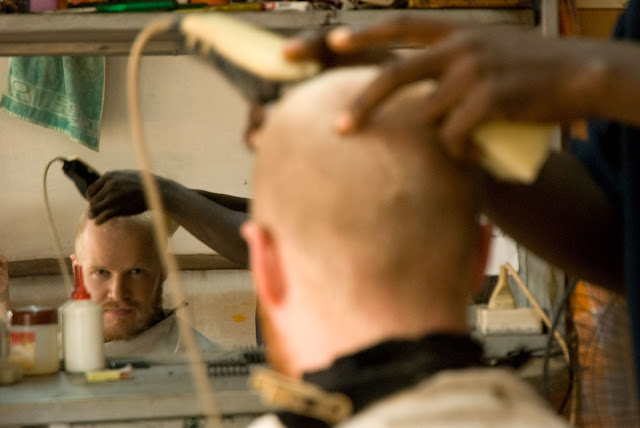
The haircut and the beard.
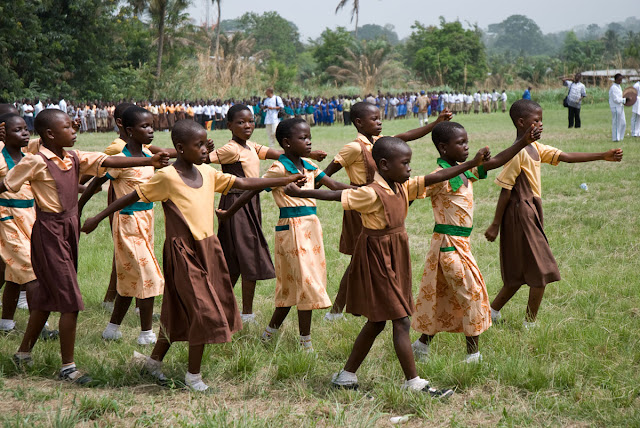
Children marching on Independence Day.

A regiment of older girls.

My friend Roselyn who visits me at the library, and a box of the cakes and meat pies she sells in town.
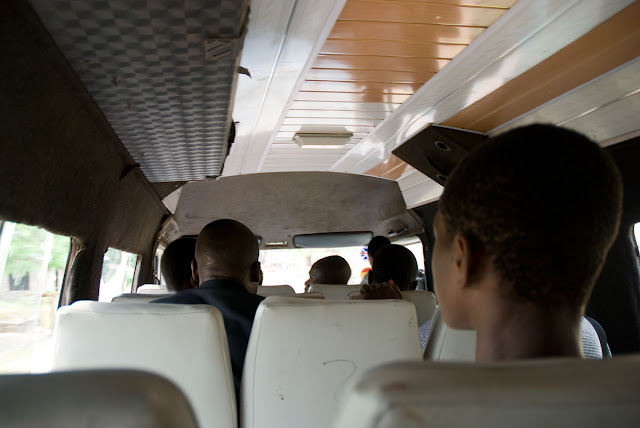
A view from the back of a tro-tro.
 Another sunset at the farm.
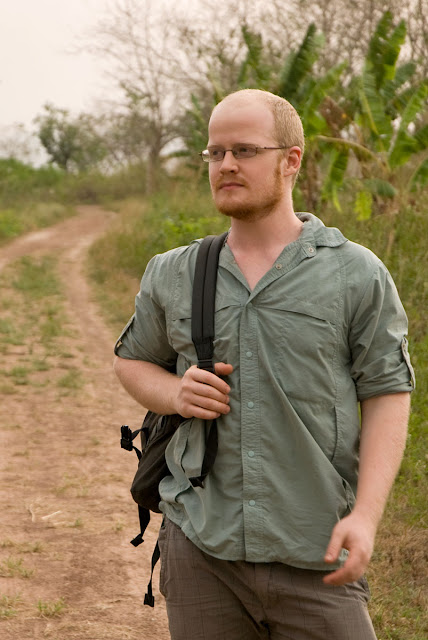
Sam, when he still recognized himself.
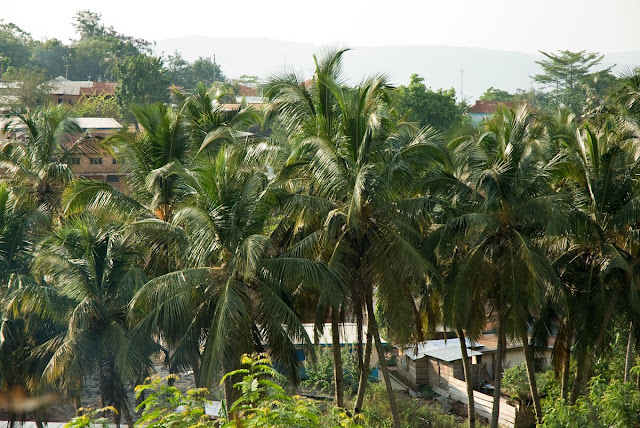
Some fetching palms.
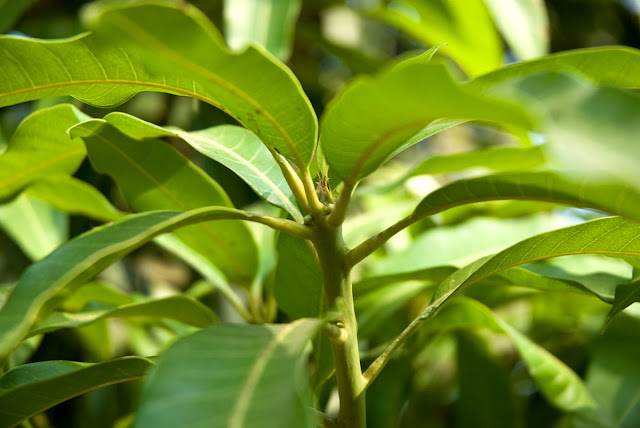
Leafy greens at the farm.

Where road rules are few, "Jesus Saves".
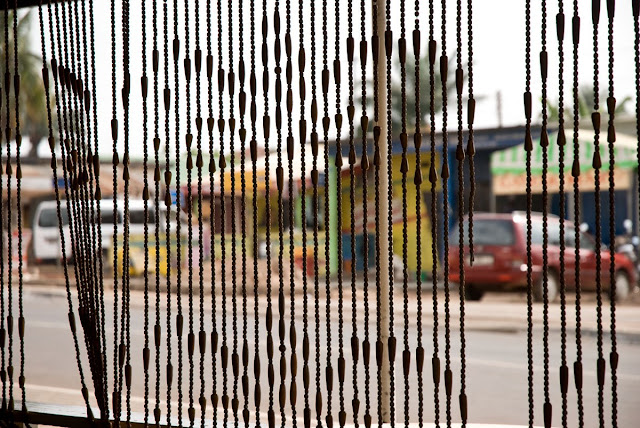
A view from a restaurant in Ho.
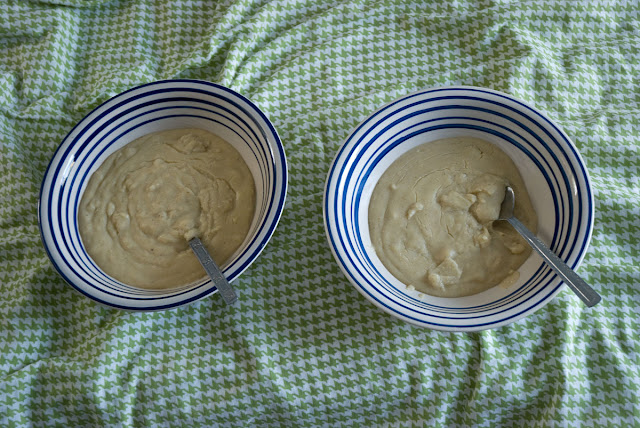
An early breakfast of "grits", which was even more awful than it looks.
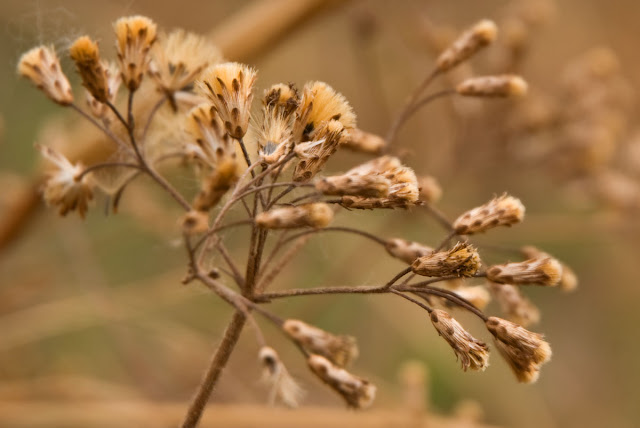
Miscellaneous flora.
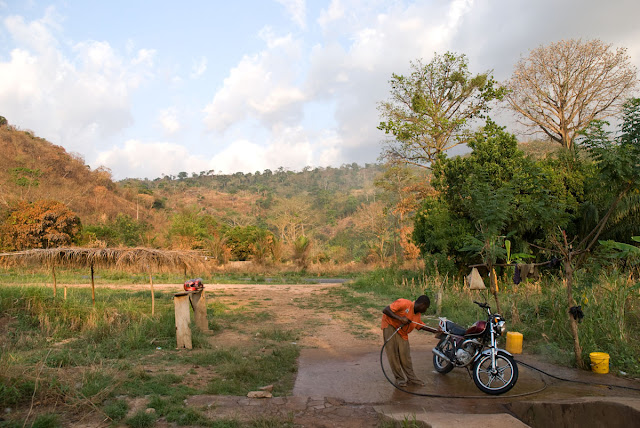
Paul's bike gets a cleaning at the Washing Station.

Sam and Anne at the base of Afadjato (actually trying to instruct our taxi driver in the use of the camera, but there you have it).

The haircut and the beard.

Children marching on Independence Day.

A regiment of older girls.

My friend Roselyn who visits me at the library, and a box of the cakes and meat pies she sells in town.

A view from the back of a tro-tro.
 Another sunset at the farm.
Sam, when he still recognized himself.

Some fetching palms.

Leafy greens at the farm.

Where road rules are few, "Jesus Saves".

A view from a restaurant in Ho.

An early breakfast of "grits", which was even more awful than it looks.

Miscellaneous flora.

Paul's bike gets a cleaning at the Washing Station.

Sam and Anne at the base of Afadjato (actually trying to instruct our taxi driver in the use of the camera, but there you have it).
What weeks 5 and 6 brought
Sunday March 1st we finally met the chief and elders of Have – something that Paul would have liked us to do much earlier, I’m sure, but for whatever reason it had been delayed. We were welcomed very warmly, in particular because we’re Canadians, and we were given a brief history of the work of other Canadians and the Canadian Government who have supported development in Have for many years. (This included work as far back as 1983 when the Canadian Government funded a generator for the town before it was hooked up to the electrical grid.) Otherwise, we had a not-uncommon busy day-about-town with Paul, which found us on various errands and then (after being served two generous 600 mL bottles of beer, the first with Paul’s best friend Constant, and the second with a visiting mentor of his) eventually found us – cautiously, nervously – drunk on a Sunday in this Christian town. Before I realized I was hot, I was tired, dehydrated, and sobering up while waiting interminable minutes on the hot road for a tro-tro to take us back to the village. One benefit of the beer, however, was that lunch of fried yam chips and tomato relish tasted amazing!
Monday March 2nd my replacement arrived at the library. Her name is Ruby and she’s a 20 year-old high-school graduate and the granddaughter of a local woman. Lately she’s been living in Accra with her step-father but she’ll be attending the library training school when the funds are found. I’d gotten pretty used to my solitude at the library but since I knew it should be the dream of every volunteer to be rendered obsolete, I was happy for the company. So far Ruby and I are getting along well except that she thinks I’m “soft” on disciplining the kids. I told her it’s just that I leave the disciplining up to her now, since she’s tough and the kids don’t laugh at her as much. Also it’s true that I am soft when it comes to the really little ones who just like to look at the books for the pictures – it seems to be the prevailing opinion among the adult visitors to the library that if the kids can’t read then they’re just causing trouble, but since it was my hobby for a great many years just to “look at the pictures” I feel like using the library for anything is nice. I’ve taken a cue from Ruby, though, (who tells the primary school kids to go home after they’ve perused one book) and I usually tell them it’s time to go after two, but sometimes I go soft and tell them to come back “later” rather than “tomorrow”.
Wednesday March 4th Sam came into town midday for a hair cut and our language lesson. The former had been planned for Monday but was scrapped when we missed our appointment with the barber. This was our first experience of real frustration with African punctuality when Ruby casually arrived back late from lunch and Jimmy (Paul’s nephew and our eager guide and shadow) wandered off to the market at the last minute making us 30 minutes late at the barber. There are other barbers in town but after I watched one cut Kilon’s hair by scraping his head with a bare razor braced on a comb I suggested Sam ask Paul if he knew of someone with a pair of clippers. So Wednesday Sam successfully got his hair cut, but he continues to puzzle with the “experiment” of his beard.
Friday March 6th was Ghana Independence Day and so both Sam and I got the day off work. The activity of the day was watching the school-children march around a field in town, and so for several hours Sam and I sat and watched in the sometimes-shade of a tree (and both managed to get our first sunburns as a result). We learned that only the best marchers from each school are chosen for this parade (this from Raymond, our Ewe teacher, who interpreted for us), and that it’s very serious business (this from the children’s faces). Between 20-40 male and female students each represented every school and each group marched in turn around the perimeter of the field to the top where they saluted the Ghanaian flag, a local government representative, and a police officer. The best part had to be the march that they did, which was an odd arm-swinging, foot-dragging, goose-stepping, almost-dancing sort of thing to a constant drum beat and the accompaniment of a motley band. The whole town showed up and sat around the field and cheered on each delegation, with some proud parents and grandparents occasionally breaking out of the crowd to hoot and holler alongside the marching students. The wee primary students were some of the cutest and even I felt a twinge of pride when I saw that a particularly quiet and precious little librarygoer was leading her brown-and-white-checkered classmates, having earned the distinction of the group leader’s sash and white gloves. On the way back to the village we stopped at the Lacumba Spot – a local drinking spot – and enjoyed our one and only Ghanaian vice: ice cold Fanta in glass bottles, 50 cents a piece.
As the heat and our discomfort continued unabated over the weekend, Monday March 8th felt like a rotten start to the next 5 weeks. In addition, some new frustrations and challenges came to a head for us at the beginning of the week. Sam and I discouragingly reflected that in some respects we still felt just as alien here as we did weeks ago and that we were beginning to harbour a great resentment for what we were feeling are some widely held prejudices against us. If we were tired of “Yevou” before, after five weeks we hated it. But more than that we hated the increased frequency with which we seemed to be hearing any number of ridiculous statements starting with “The Whites…” Particularly hurtful were an unconnected series of insinuations about “white” (read: western) culture that suggested that we are more selfish than Africans. From a Ghanaian perspective, where large extended families live together and are involved in each other’s daily lives, the way western families live apart and prefer privacy may naturally seem distant and maybe even selfish, but the assessment is completely superficial as far as we’re concerned. Even at our best (and we were not), Sam and I often needed to let off steam, and too often found ourselves ranting “Why the eff are we here?!?”
Adding to our frustrations was the food situation, which in the last week or so seemed to reach a critical new low. Breakfasts, which were once our favourite meal at least for their predictability, lost their (little) appeal, just like the rest of the food. Every morning is still the same with some variation of porridge (heaps and heaps of it; sometimes thick, sometimes thin), or if we’re very unfortunate “rice water” – which is like wet, overcooked rice pudding. Usually we’re served some kind of egg, which is at least the highlight, but even that disappeared early this week when, we presume, we ran out of eggs before market day. There’s also the very sweet bread (the only kind), if it’s not infested with ants, but then our last batch was almost inconceivably sweeter. (The Ghanaian tolerance for sugar has taken even me by surprise.) Otherwise it basically feels like for every decent lunch (and please understand that our standards are now very, very low), there’s fufu for dinner.
On Monday we got another talk from Paul about our feedback to him, which unfortunately in our dismal moods felt a bit like a lecture. We haven’t given much feedback, and I’m not sure whether he was thinking of the food or the accommodation or something else, but again he was quite insistent that he wanted us to be honest with him and tell him what we wanted. He reminded us that if we don’t like something and we don’t tell him, that we’re potentially creating a bad situation for the next volunteers. While we acknowledged privately that this is a valid point, it doesn’t help us negotiate a way to address some of our worst grievances – namely, oh say, the food and racism. He seemed to want something and so I told Paul that I’d really like a shower (that was day six without them). This made him laugh, so I guess he was glad I said so, even though he said he knew.
The problem may be simply that, apart from wanting regular showers, we really like our accommodations at the village just fine. It’s offered us some much-needed privacy from the prying eyes that find us when we’re out and about and, from what we’ve heard, sometimes invaded the village accommodations of previous volunteers. During the last week’s horrible heat wave we really could have used our fan, but the generator just won’t start. We told Paul this but he hasn’t been able to get Kilon to the village yet to have a look at it. (And we know he’s working on a long-term solution for the water so it’s seems rather unfair to continue to complain about it.) I told Paul that we are happy (with what we think he can help) and that otherwise we just have a hard time asking for things.
As for the food, which we agree is by far the worst thing to deal with, we feel that we’re in a trickier spot. After Paul’s entreaty I decided that I’d ask for more fruits and vegetables, since that’s something he mentioned early on that he was trying to encourage Florence to feed us. Otherwise we don’t really know what else we can ask for, because as far as we can tell we’re just eating what people eat here. Paul has said that he thinks Florence doesn’t feed us enough meat either, so I guess we can mention that too, but where we’re from meat is expensive so we’re quite self-conscious about making this request. Nevertheless, although the timing was bad, we took Paul’s talk to heart and asked on Thurdsay to never again be served African “bread” – an indescribable mashed-noodle-like-loaf, the colour and consistency of a hard mozzarella cheese, with the granular, pocketed interior of an Aero bar; and absolutely in Sam’s opinion the most vile food imaginable. Still, Sam and I agreed that no matter how much we hate fufu, we can’t say that we don’t like it – it’s the national dish and everyone just seems too damn proud of it!
Tuesday March 9th was a better day and I got to skip the library and play photographer for the day when a team of Dutch engineers arrived and took a tour of the area. I don’t actually know what to call them – engineers, scientists, social workers – but the three of them make up a team who is working with Paul and EDYM and the village of Wodje (just south of Have) to create an irrigation scheme for some of the almost 1200 acres of farm fields between the town and the lake. The three men met the chiefs of Wodje and as I watched their stifled bewilderment and mild discomfort (been there!), I briefly enjoyed feeling like I wasn’t the biggest stranger in town. After a hot motorcycle ride out to meet some of the farmers, followed by the Dutch and their guides in a truck, we headed back to our favourite hotel where we all had lunch, except Sam, who got to enjoy neither the day off work nor the charming and amusing company of the lanky Dutchmen.
Wednesday March 10th was a big day at the library because it was the first day with power! I moved up a big step in the world Tuesday night when we were hooked up to the electrical grid and so now I enjoy a fan and power for my laptop!!! (All of the wires and fixtures were already in place, but the power had been disconnected at some point during the last six months or so when the library was closed.) Paul has temporarily moved the EDYM offices to the library as well (which were temporarily closed and out of power since an over-height truck pulled down the connecting line), and so there is a rather small but hopeful possibility of using the internet here at some point in the future.
Wednesday also saw a vast improvement in our Ewe lessons when I suggested to Raymond a new lesson structure as an alternative to the two interminable hours of dictation of complicated phrases and vocabulary, which was making our task of learning increasingly insurmountable. We knew that this had worked when Sam found himself singing what he thought was a nonsense song during his hours of sweaty and back-breaking work, only to realize that he was actually speaking Ewe: the words to his song were, over and over, “Doh lé ñiéwu” which is (phonetic) Ewe for “I am hungry.” (Whereas I really felt myself suffering for food last week, Sam’s been feeling the pain more recently, and has begun to show the signs, often in unintentionally odd behaviour. Case in point, a few days ago as I read a book with my flashlight I heard a low whisper coming from the dark and, when I shone my flashlight, found a startled Sam who said he’d been imagining that he was eating a burger.)
Friday March 13th we finally had a big rain and, although it continues to be hot, I think we can say that the heat wave that had us suffering temperatures in the forties is behind us for now. It may still get hotter between now and when we leave – and will certainly be hotter as we head north – but I feel a cautious optimism in thinking that it would be nearly impossible to experience anything worse than what we felt last weekend, and so I will live through this heat. The frequency of the rains has increased and I had the incredible pleasure of waking up Sunday to the sound of rain on the roof and (I could have sworn) the smell of Bruce Beach in my nose. Moreover, the overnight rain was so cool that I reckoned our thermometer had the temperature too high at 25. At any rate, I lingered in a very fresh shower Sunday morning and considered that I hadn’t been so cold since we stood on the tarmac at Heathrow (in clothes suitable for neither minus 20 nor plus 30) waiting to board the shuttlebus to our plane.
Unlike the miserable and never-ending week five, week six passed rather quickly and we are now counting in days and weeks, not weeks and months, until our departure.
Monday March 2nd my replacement arrived at the library. Her name is Ruby and she’s a 20 year-old high-school graduate and the granddaughter of a local woman. Lately she’s been living in Accra with her step-father but she’ll be attending the library training school when the funds are found. I’d gotten pretty used to my solitude at the library but since I knew it should be the dream of every volunteer to be rendered obsolete, I was happy for the company. So far Ruby and I are getting along well except that she thinks I’m “soft” on disciplining the kids. I told her it’s just that I leave the disciplining up to her now, since she’s tough and the kids don’t laugh at her as much. Also it’s true that I am soft when it comes to the really little ones who just like to look at the books for the pictures – it seems to be the prevailing opinion among the adult visitors to the library that if the kids can’t read then they’re just causing trouble, but since it was my hobby for a great many years just to “look at the pictures” I feel like using the library for anything is nice. I’ve taken a cue from Ruby, though, (who tells the primary school kids to go home after they’ve perused one book) and I usually tell them it’s time to go after two, but sometimes I go soft and tell them to come back “later” rather than “tomorrow”.
Wednesday March 4th Sam came into town midday for a hair cut and our language lesson. The former had been planned for Monday but was scrapped when we missed our appointment with the barber. This was our first experience of real frustration with African punctuality when Ruby casually arrived back late from lunch and Jimmy (Paul’s nephew and our eager guide and shadow) wandered off to the market at the last minute making us 30 minutes late at the barber. There are other barbers in town but after I watched one cut Kilon’s hair by scraping his head with a bare razor braced on a comb I suggested Sam ask Paul if he knew of someone with a pair of clippers. So Wednesday Sam successfully got his hair cut, but he continues to puzzle with the “experiment” of his beard.
Friday March 6th was Ghana Independence Day and so both Sam and I got the day off work. The activity of the day was watching the school-children march around a field in town, and so for several hours Sam and I sat and watched in the sometimes-shade of a tree (and both managed to get our first sunburns as a result). We learned that only the best marchers from each school are chosen for this parade (this from Raymond, our Ewe teacher, who interpreted for us), and that it’s very serious business (this from the children’s faces). Between 20-40 male and female students each represented every school and each group marched in turn around the perimeter of the field to the top where they saluted the Ghanaian flag, a local government representative, and a police officer. The best part had to be the march that they did, which was an odd arm-swinging, foot-dragging, goose-stepping, almost-dancing sort of thing to a constant drum beat and the accompaniment of a motley band. The whole town showed up and sat around the field and cheered on each delegation, with some proud parents and grandparents occasionally breaking out of the crowd to hoot and holler alongside the marching students. The wee primary students were some of the cutest and even I felt a twinge of pride when I saw that a particularly quiet and precious little librarygoer was leading her brown-and-white-checkered classmates, having earned the distinction of the group leader’s sash and white gloves. On the way back to the village we stopped at the Lacumba Spot – a local drinking spot – and enjoyed our one and only Ghanaian vice: ice cold Fanta in glass bottles, 50 cents a piece.
As the heat and our discomfort continued unabated over the weekend, Monday March 8th felt like a rotten start to the next 5 weeks. In addition, some new frustrations and challenges came to a head for us at the beginning of the week. Sam and I discouragingly reflected that in some respects we still felt just as alien here as we did weeks ago and that we were beginning to harbour a great resentment for what we were feeling are some widely held prejudices against us. If we were tired of “Yevou” before, after five weeks we hated it. But more than that we hated the increased frequency with which we seemed to be hearing any number of ridiculous statements starting with “The Whites…” Particularly hurtful were an unconnected series of insinuations about “white” (read: western) culture that suggested that we are more selfish than Africans. From a Ghanaian perspective, where large extended families live together and are involved in each other’s daily lives, the way western families live apart and prefer privacy may naturally seem distant and maybe even selfish, but the assessment is completely superficial as far as we’re concerned. Even at our best (and we were not), Sam and I often needed to let off steam, and too often found ourselves ranting “Why the eff are we here?!?”
Adding to our frustrations was the food situation, which in the last week or so seemed to reach a critical new low. Breakfasts, which were once our favourite meal at least for their predictability, lost their (little) appeal, just like the rest of the food. Every morning is still the same with some variation of porridge (heaps and heaps of it; sometimes thick, sometimes thin), or if we’re very unfortunate “rice water” – which is like wet, overcooked rice pudding. Usually we’re served some kind of egg, which is at least the highlight, but even that disappeared early this week when, we presume, we ran out of eggs before market day. There’s also the very sweet bread (the only kind), if it’s not infested with ants, but then our last batch was almost inconceivably sweeter. (The Ghanaian tolerance for sugar has taken even me by surprise.) Otherwise it basically feels like for every decent lunch (and please understand that our standards are now very, very low), there’s fufu for dinner.
On Monday we got another talk from Paul about our feedback to him, which unfortunately in our dismal moods felt a bit like a lecture. We haven’t given much feedback, and I’m not sure whether he was thinking of the food or the accommodation or something else, but again he was quite insistent that he wanted us to be honest with him and tell him what we wanted. He reminded us that if we don’t like something and we don’t tell him, that we’re potentially creating a bad situation for the next volunteers. While we acknowledged privately that this is a valid point, it doesn’t help us negotiate a way to address some of our worst grievances – namely, oh say, the food and racism. He seemed to want something and so I told Paul that I’d really like a shower (that was day six without them). This made him laugh, so I guess he was glad I said so, even though he said he knew.
The problem may be simply that, apart from wanting regular showers, we really like our accommodations at the village just fine. It’s offered us some much-needed privacy from the prying eyes that find us when we’re out and about and, from what we’ve heard, sometimes invaded the village accommodations of previous volunteers. During the last week’s horrible heat wave we really could have used our fan, but the generator just won’t start. We told Paul this but he hasn’t been able to get Kilon to the village yet to have a look at it. (And we know he’s working on a long-term solution for the water so it’s seems rather unfair to continue to complain about it.) I told Paul that we are happy (with what we think he can help) and that otherwise we just have a hard time asking for things.
As for the food, which we agree is by far the worst thing to deal with, we feel that we’re in a trickier spot. After Paul’s entreaty I decided that I’d ask for more fruits and vegetables, since that’s something he mentioned early on that he was trying to encourage Florence to feed us. Otherwise we don’t really know what else we can ask for, because as far as we can tell we’re just eating what people eat here. Paul has said that he thinks Florence doesn’t feed us enough meat either, so I guess we can mention that too, but where we’re from meat is expensive so we’re quite self-conscious about making this request. Nevertheless, although the timing was bad, we took Paul’s talk to heart and asked on Thurdsay to never again be served African “bread” – an indescribable mashed-noodle-like-loaf, the colour and consistency of a hard mozzarella cheese, with the granular, pocketed interior of an Aero bar; and absolutely in Sam’s opinion the most vile food imaginable. Still, Sam and I agreed that no matter how much we hate fufu, we can’t say that we don’t like it – it’s the national dish and everyone just seems too damn proud of it!
Tuesday March 9th was a better day and I got to skip the library and play photographer for the day when a team of Dutch engineers arrived and took a tour of the area. I don’t actually know what to call them – engineers, scientists, social workers – but the three of them make up a team who is working with Paul and EDYM and the village of Wodje (just south of Have) to create an irrigation scheme for some of the almost 1200 acres of farm fields between the town and the lake. The three men met the chiefs of Wodje and as I watched their stifled bewilderment and mild discomfort (been there!), I briefly enjoyed feeling like I wasn’t the biggest stranger in town. After a hot motorcycle ride out to meet some of the farmers, followed by the Dutch and their guides in a truck, we headed back to our favourite hotel where we all had lunch, except Sam, who got to enjoy neither the day off work nor the charming and amusing company of the lanky Dutchmen.
Wednesday March 10th was a big day at the library because it was the first day with power! I moved up a big step in the world Tuesday night when we were hooked up to the electrical grid and so now I enjoy a fan and power for my laptop!!! (All of the wires and fixtures were already in place, but the power had been disconnected at some point during the last six months or so when the library was closed.) Paul has temporarily moved the EDYM offices to the library as well (which were temporarily closed and out of power since an over-height truck pulled down the connecting line), and so there is a rather small but hopeful possibility of using the internet here at some point in the future.
Wednesday also saw a vast improvement in our Ewe lessons when I suggested to Raymond a new lesson structure as an alternative to the two interminable hours of dictation of complicated phrases and vocabulary, which was making our task of learning increasingly insurmountable. We knew that this had worked when Sam found himself singing what he thought was a nonsense song during his hours of sweaty and back-breaking work, only to realize that he was actually speaking Ewe: the words to his song were, over and over, “Doh lé ñiéwu” which is (phonetic) Ewe for “I am hungry.” (Whereas I really felt myself suffering for food last week, Sam’s been feeling the pain more recently, and has begun to show the signs, often in unintentionally odd behaviour. Case in point, a few days ago as I read a book with my flashlight I heard a low whisper coming from the dark and, when I shone my flashlight, found a startled Sam who said he’d been imagining that he was eating a burger.)
Friday March 13th we finally had a big rain and, although it continues to be hot, I think we can say that the heat wave that had us suffering temperatures in the forties is behind us for now. It may still get hotter between now and when we leave – and will certainly be hotter as we head north – but I feel a cautious optimism in thinking that it would be nearly impossible to experience anything worse than what we felt last weekend, and so I will live through this heat. The frequency of the rains has increased and I had the incredible pleasure of waking up Sunday to the sound of rain on the roof and (I could have sworn) the smell of Bruce Beach in my nose. Moreover, the overnight rain was so cool that I reckoned our thermometer had the temperature too high at 25. At any rate, I lingered in a very fresh shower Sunday morning and considered that I hadn’t been so cold since we stood on the tarmac at Heathrow (in clothes suitable for neither minus 20 nor plus 30) waiting to board the shuttlebus to our plane.
Unlike the miserable and never-ending week five, week six passed rather quickly and we are now counting in days and weeks, not weeks and months, until our departure.
The HEAT (or; You can run, but that’ll only kill you sooner.)
Friday March 6, 2009:
Ugh, where do we begin? How about with a colossal understatement? The last week or so has been hot. If you’ve already used all your adjectives, what do you write when it gets hotter?
We took out Sam’s thermometer today and confirmed that it was working. It went from it’s near-constant 34-35°C (in our room) down to a mercifully cool 29°C for a short time this evening after a small rain. We’ve been begging for rain for a week because we keep being assured that then it will cool down, but instead of the deluge everyone’s been promising we got one of the small showers that only wets the ground and “let’s the heat out,” making things worse.
Paul is out of town and has been most of this week. Monday and Tuesday he was in Accra deliver his thesis project (for a Diploma in Youth and Development Work) to the University Ghana, Wednesday he was in Ho at a meeting of a regional forestry board, and Thursday he left again for Accra for a conference of a Moringa association of which he’s a founding member. We expect him back tomorrow night at the earliest. Our water tank for showers ran out Tuesday and Paul was unable to reach his friend with the truck before he left. Tonight will be our fourth night without showers, and about a week into this increasingly brutal heat wave.
Making matters even worse than that is the food situation, which can only be described as grim. Sam's doing better than I am, I think because he's tougher and probably has a better (or less dark) sense of humour about it. Or maybe he’s just hungrier. As with most things I don't like doing but have to do, I have a hard time imagining things ever being better, or the current situation not lasting forever, and so I'm generally more sullen about it. I’m feeling pretty desperate for something other than our regulars: beans and plantains; spaghetti which has lately been too spicy; fufu and banku which I'm so hungry I'm devouring now; minor variations on rice.
That being said, I’ve been eating less and less this week (probably on account of both the heat and the food) and that, along with some mild dehydration, has created a very bad situation for my system, if you get my meaning. (I only wish to give you a full picture of my suffering.) When I consulted the Collins Family Health Medical Encyclopedia at the library it gave me a probable cause: starvation. This adds a particular irony to that old phrase, “Eat up, there are people starving in Africa.” I never thought they could mean me! Sam and I have made a pact to get out of the village tomorrow if only to experience the incredible freedom of deciding which bad food we’ll eat.
Saturday March 7, 2009:
I read the section on food in the introduction to the Lonely Planet Guide to Africa and did something just short spitting on the book and throwing it across the room. It was extolling the delights of the many and varied grains and root vegetables that are pounded into mush (amazingly from East to West, North to South!) and the stews (fish or goat or chicken!) with which they’re eaten.
Our favourite and most painful daydreams are about food – big macs or club sandwiches or anything crispy and fresh or "Porridge!" Sam loves to say, as we're eating our regular morning porridge, which we also hate now. We’ve planned every meal for at least the first two weeks of our return to Canada.
We decided to take the quick trip to Kpandu today to see if we could find working internet, even though we were warned by Paul that it would be disappointingly slow. The trip is really less about this than getting away from the village, where it will be almost too hot to sit around and certainly too hot to risk being co-opted into work. (We are a proud example of volunteers.) We think that it's possible that the only restaurant in town is a place called "Roses" where we came with Edward on our way back to the village during our Excursion. There we had something called a Club Sandwich and a Complete Salad, both of which were definitely weird but sort of not awful, so maybe we'll get them again. (As far as we can tell there's no lettuce in Ghana, and so anything green is usually cabbage and any salad is usually coleslaw, unless it's Florence's/Paul's and then it's fishy. So the Club Sandwich that we had was actually just coleslaw and the standard fried chicken between three pieces of the weird sweet bread. Like I said, not awful, but not great.)
When I checked my email in Kpandu I’d received a note from Mum about the heat. On Wednesday I called home to wish Dad a happy birthday and (as they stood on the breezy summit of Blue Mountain) I told them how I was essentially sitting in my underwear and still couldn’t keep myself dry. It’s the humidity that’s the real killer and that’s something we can’t get a measure of. We’re assured though that it sits at a constant 80% or so, or higher. According to Mum the weather network pegged it at 28°C at 3:00 am on Thursday in Accra, with 84% relative humidity making it feel like 41°C in the middle of the night. She recons that 34°C must then feel like 50°C.
At 2:00pm on Saturday March 7th I measure 42°C on the thermometer while walking back on the road to the farm, before a relative humidity that must be at least 80%. I measured the same on my lap in the front seat of the tro-tro coming back from Kpandu. What does that make it?
Paul didn’t return tonight and so we’re still without showers. Day 5. The club sandwiches were indeed weird again and pretty unsatisfying. We thought we’d try something else on the menu but we’re learning that a menu in a Ghanaian restaurant is less a list of things that are available to eat than it is a list of things that might have been once made in this or possibly some other kitchen. We noticed that these club sandwiches had egg in them, and decidedly less chicken. We also tried a Tomato Salad which didn’t disappoint – it appeared to be what it said it was and so we had what I think might have been our first veggies in a week. I might also be suffering from a lack of fruits and vegetables in addition to a lack of water. Knowing this, I still have trouble eating or drinking much and I had my ever-present stomach-ache by the time we arrived back at the farm.
Sunday March 8, 2009:
Things went from bad to worse last night with my stomach and I spent most of the night either pacing the driveway, curled up on the floor in a corner of our room (I was too uncomfortable to lie down), or in the bathroom. I will admit that I cried – from exhaustion and from hunger pains that may actually be indigestion since neither food nor water seems to quench my apparent hunger and thirst. I took some pills and eventually things improved, but not before the stomach pains made me throw up – once in a bucket in our room and another time in the bathroom after which I briefly blacked out and fell (not far) to the floor and forgot where I was.
Luckily we have nothing pressing to do today except wait on Paul and more pure water for drinking (we’ve run out and as a replacement Chachu’s brought us some bags of water that are either very old or have somehow otherwise taken on the powerful taste of the plastic and so they’re basically undrinkable). I am feeling tired but significantly better. The weather is about the same – hotter than hot and getting hotter.
When Paul returned this afternoon he brought drinking water and we headed off to the hotel for a drink. I opted for Fanta (one standard 600mL bottle of beer is usually more than enough for me and sometimes Paul serves us two) but Sam saved me and Paul’s disappointment by drinking beer as well. While we were sitting at the hotel it started to rain! It rained and rained and rained and I started dreaming of showers again. At day 6 without water, they can’t be far away, can they? (We would wait until Wednesday – Day 8.)
At EDYM village after the storm I measured 25°C!! Today marks our exact halfway point in this stay. Five weeks down, five more to go.
Ugh, where do we begin? How about with a colossal understatement? The last week or so has been hot. If you’ve already used all your adjectives, what do you write when it gets hotter?
We took out Sam’s thermometer today and confirmed that it was working. It went from it’s near-constant 34-35°C (in our room) down to a mercifully cool 29°C for a short time this evening after a small rain. We’ve been begging for rain for a week because we keep being assured that then it will cool down, but instead of the deluge everyone’s been promising we got one of the small showers that only wets the ground and “let’s the heat out,” making things worse.
Paul is out of town and has been most of this week. Monday and Tuesday he was in Accra deliver his thesis project (for a Diploma in Youth and Development Work) to the University Ghana, Wednesday he was in Ho at a meeting of a regional forestry board, and Thursday he left again for Accra for a conference of a Moringa association of which he’s a founding member. We expect him back tomorrow night at the earliest. Our water tank for showers ran out Tuesday and Paul was unable to reach his friend with the truck before he left. Tonight will be our fourth night without showers, and about a week into this increasingly brutal heat wave.
Making matters even worse than that is the food situation, which can only be described as grim. Sam's doing better than I am, I think because he's tougher and probably has a better (or less dark) sense of humour about it. Or maybe he’s just hungrier. As with most things I don't like doing but have to do, I have a hard time imagining things ever being better, or the current situation not lasting forever, and so I'm generally more sullen about it. I’m feeling pretty desperate for something other than our regulars: beans and plantains; spaghetti which has lately been too spicy; fufu and banku which I'm so hungry I'm devouring now; minor variations on rice.
That being said, I’ve been eating less and less this week (probably on account of both the heat and the food) and that, along with some mild dehydration, has created a very bad situation for my system, if you get my meaning. (I only wish to give you a full picture of my suffering.) When I consulted the Collins Family Health Medical Encyclopedia at the library it gave me a probable cause: starvation. This adds a particular irony to that old phrase, “Eat up, there are people starving in Africa.” I never thought they could mean me! Sam and I have made a pact to get out of the village tomorrow if only to experience the incredible freedom of deciding which bad food we’ll eat.
Saturday March 7, 2009:
I read the section on food in the introduction to the Lonely Planet Guide to Africa and did something just short spitting on the book and throwing it across the room. It was extolling the delights of the many and varied grains and root vegetables that are pounded into mush (amazingly from East to West, North to South!) and the stews (fish or goat or chicken!) with which they’re eaten.
Our favourite and most painful daydreams are about food – big macs or club sandwiches or anything crispy and fresh or "Porridge!" Sam loves to say, as we're eating our regular morning porridge, which we also hate now. We’ve planned every meal for at least the first two weeks of our return to Canada.
We decided to take the quick trip to Kpandu today to see if we could find working internet, even though we were warned by Paul that it would be disappointingly slow. The trip is really less about this than getting away from the village, where it will be almost too hot to sit around and certainly too hot to risk being co-opted into work. (We are a proud example of volunteers.) We think that it's possible that the only restaurant in town is a place called "Roses" where we came with Edward on our way back to the village during our Excursion. There we had something called a Club Sandwich and a Complete Salad, both of which were definitely weird but sort of not awful, so maybe we'll get them again. (As far as we can tell there's no lettuce in Ghana, and so anything green is usually cabbage and any salad is usually coleslaw, unless it's Florence's/Paul's and then it's fishy. So the Club Sandwich that we had was actually just coleslaw and the standard fried chicken between three pieces of the weird sweet bread. Like I said, not awful, but not great.)
When I checked my email in Kpandu I’d received a note from Mum about the heat. On Wednesday I called home to wish Dad a happy birthday and (as they stood on the breezy summit of Blue Mountain) I told them how I was essentially sitting in my underwear and still couldn’t keep myself dry. It’s the humidity that’s the real killer and that’s something we can’t get a measure of. We’re assured though that it sits at a constant 80% or so, or higher. According to Mum the weather network pegged it at 28°C at 3:00 am on Thursday in Accra, with 84% relative humidity making it feel like 41°C in the middle of the night. She recons that 34°C must then feel like 50°C.
At 2:00pm on Saturday March 7th I measure 42°C on the thermometer while walking back on the road to the farm, before a relative humidity that must be at least 80%. I measured the same on my lap in the front seat of the tro-tro coming back from Kpandu. What does that make it?
Paul didn’t return tonight and so we’re still without showers. Day 5. The club sandwiches were indeed weird again and pretty unsatisfying. We thought we’d try something else on the menu but we’re learning that a menu in a Ghanaian restaurant is less a list of things that are available to eat than it is a list of things that might have been once made in this or possibly some other kitchen. We noticed that these club sandwiches had egg in them, and decidedly less chicken. We also tried a Tomato Salad which didn’t disappoint – it appeared to be what it said it was and so we had what I think might have been our first veggies in a week. I might also be suffering from a lack of fruits and vegetables in addition to a lack of water. Knowing this, I still have trouble eating or drinking much and I had my ever-present stomach-ache by the time we arrived back at the farm.
Sunday March 8, 2009:
Things went from bad to worse last night with my stomach and I spent most of the night either pacing the driveway, curled up on the floor in a corner of our room (I was too uncomfortable to lie down), or in the bathroom. I will admit that I cried – from exhaustion and from hunger pains that may actually be indigestion since neither food nor water seems to quench my apparent hunger and thirst. I took some pills and eventually things improved, but not before the stomach pains made me throw up – once in a bucket in our room and another time in the bathroom after which I briefly blacked out and fell (not far) to the floor and forgot where I was.
Luckily we have nothing pressing to do today except wait on Paul and more pure water for drinking (we’ve run out and as a replacement Chachu’s brought us some bags of water that are either very old or have somehow otherwise taken on the powerful taste of the plastic and so they’re basically undrinkable). I am feeling tired but significantly better. The weather is about the same – hotter than hot and getting hotter.
When Paul returned this afternoon he brought drinking water and we headed off to the hotel for a drink. I opted for Fanta (one standard 600mL bottle of beer is usually more than enough for me and sometimes Paul serves us two) but Sam saved me and Paul’s disappointment by drinking beer as well. While we were sitting at the hotel it started to rain! It rained and rained and rained and I started dreaming of showers again. At day 6 without water, they can’t be far away, can they? (We would wait until Wednesday – Day 8.)
At EDYM village after the storm I measured 25°C!! Today marks our exact halfway point in this stay. Five weeks down, five more to go.
Saturday, February 28, 2009
More photos from Ghana
 Sunset at the EDYM village.
 A typical tro-tro (overloaded boot'n'all).
 Laundry day at the farm.
Our humble abode.
 Ho, the regional capital and home to the Anointed Internet Cafe.
 Seeking shelter from the storm at the library.
 Paul, casually waiting it out.
 A hungry mommy Mona Monkey, at the Tafi Atome Sanctuary.
In front of Wli Waterfalls.

Right under the falls.
Eating with your hands for dummies
Food
Let it be known that I love food. At least I love food that I love, which I am aware is as useful as it is informative. Bearing this in mind a trip to Africa, and possibly beyond, held for me a particular thrill in the promise of foreign savory dishes and exotic culinary delights. I remember thinking that, what can only be described as living in Ghana (at least for a short while), would provide the opportunity to become well acquainted with new and exciting local cooking. And acquainted we have become.
Japanese sushi - I crave, Chinese noodles - I hunger for, Indian - I delight in, Korean BBQ I have defeated; all of these cuisines (and many others) I have conquered with the care of a gourmet and the appetite of a gourmand. To Ghana I say, "touche" and respectfully bow out of the ring.
To say that Ghanaian cooking, and more importantly Ghanaian eating etiquette, is strange and foreign to me would be at least a slight understatement. Suffice it to say that living in this indomitable heat without electricity or the certainty of running water finds Anne and me dreaming, both day and night, not of air conditioned luxury, but of egg salad sandwiches (with crispy lettuce of course), pink lemonade, and chicken wings. Our meals instead consist of a variety of dishes that are made, predominately, from the pounding and mushing of a variety of bland root plants. The results are foufou, banku, and at least 2 or 3 other dishes that have sounds in the pronunciation not found in the English language (ie. I have no idea how to write them down), all of which are served in a large communal bowl and accompanied by, either on top or aside for dipping, a stew-like soup of meat broth and herbs, the favorite of the locals being a sloppy fish dish (the resulting stew is sloppy, I'm not sure what a sloppy fish is). The meal is then eaten with your hand, mind you the right hand only - most likely a tribute to times when the left hand was strictly regulated for other purposes, but now merely represents a taboo. The design is to take a small amount of the dish in question, approx. 1/4 of a handful, and roll it into a ball (anyway you can) and then dip it into the soup and slurp it noisily from your fingers. The important skill to remember, especially when dealing with foufou (as told to us by our hosts), is not to chew but to swallow whole whatever you put in your mouth. This can be seen in some ways as a godsend as the taste is lacking and chewing foufou would be an act of futility as it has the consistency of somewhat congealed fat, yum!
This somewhat colourful introduction to Ghanaian cooking complete, it is important to note that not everything we're served is a pile of communal goop and is often palatable. Everyday we are served 3 square meals from our somewhat indifferent cook Florence. Breakfast consists of oatmeal of varying consistencies, an omelette made with the local miracle plant moringa, and bread that tastes as though it was made with sugar rather than flour. If you so wish you can also 'butter' your bread with Blue Band 70% fat spread, which will invariably have a few dead ants in it that somehow bested its seal. Lunch can be one of the aforementioned Ghanaian delights or, and to our salvation, a dish of rice or thin spaghetti mixed with a tomato relish and finished off with either papaya, bananas, or orange slices - a note on fruit in Ghana: though very fresh everything tastes just a little less juicy than the imports at home. Pesticides? Western genetic tampering? Dinner and lunch are essentially the same and either could be substituted for the other. Our favourites are the rice and pasta dishes with a little chopped up (bones and all) fried chicken or mystery meat. Throw in fried plantains and beans and you have the complete menu at Chez EDYM.
The difficulty that we have is that we are not satiated by the food and are always harbouring slight pangs of hunger. We don't think we're starving by any stretch of the imagination but our trials have lead us to believe that there is a direct correlation between feeling satisfied with a meal and the amount of chewing that was involved. This leads to our deeming dishes such as jolif of rice (rice with some spices), which would generally be described as good or at least passable, to be instead delicious and a triumph of Florence's skill.
On the lighter side we are getting much better at making the required balls of goo and yesterday both agreed that banku "wasn't actually all that bad". Coke, Fanta, FanChoco (frozen chocolate milk that you bite the corner of the bag to drink while you melt it with the warmth of your hands and the Ghanaian sun), and Sri Lankan shortbread, though only available when we travel into a town, are a constant saving grace. There was a disagreeable incident with Digestive Biscuits and an invading ant colony that will always remain a sore spot.
I still love food, maybe even moreso. However, what began as an anticipated joyful culinary adventure has metamorphosed into a stoic resolve to weather the next few months and hold fast to the constant dream and hope that we will again see the Golden Arches on the horizon.
- Sam
Let it be known that I love food. At least I love food that I love, which I am aware is as useful as it is informative. Bearing this in mind a trip to Africa, and possibly beyond, held for me a particular thrill in the promise of foreign savory dishes and exotic culinary delights. I remember thinking that, what can only be described as living in Ghana (at least for a short while), would provide the opportunity to become well acquainted with new and exciting local cooking. And acquainted we have become.
Japanese sushi - I crave, Chinese noodles - I hunger for, Indian - I delight in, Korean BBQ I have defeated; all of these cuisines (and many others) I have conquered with the care of a gourmet and the appetite of a gourmand. To Ghana I say, "touche" and respectfully bow out of the ring.
To say that Ghanaian cooking, and more importantly Ghanaian eating etiquette, is strange and foreign to me would be at least a slight understatement. Suffice it to say that living in this indomitable heat without electricity or the certainty of running water finds Anne and me dreaming, both day and night, not of air conditioned luxury, but of egg salad sandwiches (with crispy lettuce of course), pink lemonade, and chicken wings. Our meals instead consist of a variety of dishes that are made, predominately, from the pounding and mushing of a variety of bland root plants. The results are foufou, banku, and at least 2 or 3 other dishes that have sounds in the pronunciation not found in the English language (ie. I have no idea how to write them down), all of which are served in a large communal bowl and accompanied by, either on top or aside for dipping, a stew-like soup of meat broth and herbs, the favorite of the locals being a sloppy fish dish (the resulting stew is sloppy, I'm not sure what a sloppy fish is). The meal is then eaten with your hand, mind you the right hand only - most likely a tribute to times when the left hand was strictly regulated for other purposes, but now merely represents a taboo. The design is to take a small amount of the dish in question, approx. 1/4 of a handful, and roll it into a ball (anyway you can) and then dip it into the soup and slurp it noisily from your fingers. The important skill to remember, especially when dealing with foufou (as told to us by our hosts), is not to chew but to swallow whole whatever you put in your mouth. This can be seen in some ways as a godsend as the taste is lacking and chewing foufou would be an act of futility as it has the consistency of somewhat congealed fat, yum!
This somewhat colourful introduction to Ghanaian cooking complete, it is important to note that not everything we're served is a pile of communal goop and is often palatable. Everyday we are served 3 square meals from our somewhat indifferent cook Florence. Breakfast consists of oatmeal of varying consistencies, an omelette made with the local miracle plant moringa, and bread that tastes as though it was made with sugar rather than flour. If you so wish you can also 'butter' your bread with Blue Band 70% fat spread, which will invariably have a few dead ants in it that somehow bested its seal. Lunch can be one of the aforementioned Ghanaian delights or, and to our salvation, a dish of rice or thin spaghetti mixed with a tomato relish and finished off with either papaya, bananas, or orange slices - a note on fruit in Ghana: though very fresh everything tastes just a little less juicy than the imports at home. Pesticides? Western genetic tampering? Dinner and lunch are essentially the same and either could be substituted for the other. Our favourites are the rice and pasta dishes with a little chopped up (bones and all) fried chicken or mystery meat. Throw in fried plantains and beans and you have the complete menu at Chez EDYM.
The difficulty that we have is that we are not satiated by the food and are always harbouring slight pangs of hunger. We don't think we're starving by any stretch of the imagination but our trials have lead us to believe that there is a direct correlation between feeling satisfied with a meal and the amount of chewing that was involved. This leads to our deeming dishes such as jolif of rice (rice with some spices), which would generally be described as good or at least passable, to be instead delicious and a triumph of Florence's skill.
On the lighter side we are getting much better at making the required balls of goo and yesterday both agreed that banku "wasn't actually all that bad". Coke, Fanta, FanChoco (frozen chocolate milk that you bite the corner of the bag to drink while you melt it with the warmth of your hands and the Ghanaian sun), and Sri Lankan shortbread, though only available when we travel into a town, are a constant saving grace. There was a disagreeable incident with Digestive Biscuits and an invading ant colony that will always remain a sore spot.
I still love food, maybe even moreso. However, what began as an anticipated joyful culinary adventure has metamorphosed into a stoic resolve to weather the next few months and hold fast to the constant dream and hope that we will again see the Golden Arches on the horizon.
- Sam
A Slice of Life
And so here begins our new series in which we are pleased to bring you, armchair tourists, a taste of what everyday life is like around the world (but actually more specifically our limited experience in Ghana and maybe wherever else we end up). We hope to explore a range of topics from transportation to telecommunication; waste disposal to wedding proposals. Got a predilection for plumbing? We might cover that too! Tell us your fancy! We live to tell you what little we know. (In case you miss it here, look for all of the above in our surely soon-to-be-published Lonely on this Planet: A guide to not understanding cultures around the world.)
Waste Disposal
Let’s say that our observations are that Ghana’s waste disposal policy is decidedly DIY. There is none. Garbage is everywhere. Once we saw a town with garbage cans near a tourist area. (At that same tourist spot there were both very empty garbage cans and trash everywhere.) Once we saw a group of kids picking up garbage along a town road, carrying a sign that read “Reduce Litter,” and on the same day passed what we guessed to be a town dump (a large area next to some homes and stores piled with garbage, some of which was burning). Otherwise, garbage lies at the side of every road, clogs every gutter, and litters every green space all the way up to the top of Ghana’s tallest mountain. Small garbage fires occasionally burn along the road or behind houses. The best way to dispose of the garbage in your hand is to throw in on the ground.
To be fair, the amount of waste generated by a single person in a day is really very low, especially by Western standards. The vast majority of food is bought fresh (sans packaging) and prepared at home; the notable exception to this being discarded water sachets. Nevertheless, our delicate Western sensibilities being what they are, it is plain to us that the small print (“Keep Your City Clean”) on every sachet and food wrapper is patently ignored.
Recycling
Paul collects the plastic sachets from the water consumed on the farm and piles them in a storage hole in the nursery. These are then sometimes used as planting bags for seedlings grown in the nursery. (Sometimes, depending perhaps on the planter’s enthusiasm for tediously cutting open one side of every pouch.) For all other plastic, cans, bottles, cardboard and the rest, see Waste Disposal, above.
*** Okay, editor’s note: Clearly, my first assessment of recycling in Ghana was very low, but after being offered just yesterday a frothy green liquid (to drink?), obviously homemade and rebottled in a used one and a half litre water bottle, I decided it would only be fair to mention that here. Water bottles are often reused for this purpose, and they’re not all. Truthfully it is pretty clear that everything in Ghana (like our mosquito net, and our generator, to start; like peoples cars, bikes, clothes, furniture, tools, and building supplies) is milked for the absolute full measure of its usable life before it’s passed on, maybe for someone to fix and gain further use from. Also, we have received warnings that if we buy bottled water we must check that the bottles are sealed, as some people make a business out of selling tap water under the label of “pure” simply in old bottles. Reduce, Reuse, Recycle!
Waste Disposal
Let’s say that our observations are that Ghana’s waste disposal policy is decidedly DIY. There is none. Garbage is everywhere. Once we saw a town with garbage cans near a tourist area. (At that same tourist spot there were both very empty garbage cans and trash everywhere.) Once we saw a group of kids picking up garbage along a town road, carrying a sign that read “Reduce Litter,” and on the same day passed what we guessed to be a town dump (a large area next to some homes and stores piled with garbage, some of which was burning). Otherwise, garbage lies at the side of every road, clogs every gutter, and litters every green space all the way up to the top of Ghana’s tallest mountain. Small garbage fires occasionally burn along the road or behind houses. The best way to dispose of the garbage in your hand is to throw in on the ground.
To be fair, the amount of waste generated by a single person in a day is really very low, especially by Western standards. The vast majority of food is bought fresh (sans packaging) and prepared at home; the notable exception to this being discarded water sachets. Nevertheless, our delicate Western sensibilities being what they are, it is plain to us that the small print (“Keep Your City Clean”) on every sachet and food wrapper is patently ignored.
Recycling
Paul collects the plastic sachets from the water consumed on the farm and piles them in a storage hole in the nursery. These are then sometimes used as planting bags for seedlings grown in the nursery. (Sometimes, depending perhaps on the planter’s enthusiasm for tediously cutting open one side of every pouch.) For all other plastic, cans, bottles, cardboard and the rest, see Waste Disposal, above.
*** Okay, editor’s note: Clearly, my first assessment of recycling in Ghana was very low, but after being offered just yesterday a frothy green liquid (to drink?), obviously homemade and rebottled in a used one and a half litre water bottle, I decided it would only be fair to mention that here. Water bottles are often reused for this purpose, and they’re not all. Truthfully it is pretty clear that everything in Ghana (like our mosquito net, and our generator, to start; like peoples cars, bikes, clothes, furniture, tools, and building supplies) is milked for the absolute full measure of its usable life before it’s passed on, maybe for someone to fix and gain further use from. Also, we have received warnings that if we buy bottled water we must check that the bottles are sealed, as some people make a business out of selling tap water under the label of “pure” simply in old bottles. Reduce, Reuse, Recycle!
Another two weeks of fufu
So, two more weeks and what do we have to say for ourselves? Well on the positive side we’re starting to get the hang of things and are really settling in. On the less positive side our settling in has been sometimes tough going, with so many foreign things (the weather, the language, the food, the place, the culture) to adjust to all at once. While these weeks (and consequently this post) have been somewhat dominated by a few recurring negative themes as we struggle over the first hump, even as I write this I feel the need to mention quite optimistically that I think in the last few days we’ve started to turn the corner.
Starting with the positive; things we are getting used to… We have definitely come to consider the EDYM Village our sanctuary – our home away – to which we’re always pleased and comforted to return. We are generally untroubled by our relatively sparse accommodations there and have even learned to bathe – relatively happily – African-style (with a bucket) when our shower water shortages extend for longer than expected. (I will admit, though, for all my camping know-how, that I exhibited some consternation upon my first African bath at being instructed by Sam to wash my hair by sticking my head in the bucket. This is done, I will say, with very little grace.) The only real complaint we have is that Florence’s cooking continues to leave much to be desired. But it should be said that to this our approach has remained one of steadfast politeness and so, given our host’s oft-stated request for honesty, we only have ourselves to blame.
The heat – our foremost foe early on – improved greatly after our first week and, although we seem in these last few days to be in the thick of another wave, our bodies and minds have become much more accustomed to it. We’ve also benefited from some nights of stormier weather which have brought the perfect combination of cool winds blowing in from nearby storms accompanied by actually very little rain (all the cooling of a storm with none of the sogging). In fact, the reservoir is so empty that the frogs have nearly all shut up!
When he’s not too busy with all the business of the farm or tearing around town on errands on his motorcycle (sometimes with us on board), Paul laughs a lot and has been kind to let us enjoy a good deal of his company. He has been very generous with his time with us, especially given all of his commitments, and has helped us greatly with whatever assimilation into this community we have managed. A highlight are our refreshing trips to a small hotel in the next town (owned by a friend of Paul’s and consisting of a few nice small buildings in a gated property, located preposterously at the end of an extensive lane of mud huts) where we have been a few times to enjoy bottles of local beer, a refreshingly air-conditioned room, and occasionally television programmes from South Africa’s AfricaMagic! Channel (which really deserve a blog post all their own).
I’m still going to the library each day and, after a few days of chaos, I have managed to establish a relative calm and a generally good rapport with even my most snot-nosed patrons. The crowd is kept to a minimum and kids are, good-naturedly, kicked out often, and everyone gets their turn and is invited back tomorrow. The small group of children who so vexed me in my second week (who’s staring at the door turned into a great game of who could get me most worked up, climaxing in sticks being thrown repeatedly through the entrance) leave me mostly alone, or actually visit the library properly, after I told on the oldest girl to her mom. Maybe it was that, or the progressively more mundane regularity of my appearance there, or possibly some more forceful instruction from their teachers (who also visit regularly), but the children are treating me much more like an adult of consequence rather than an alien with no bearing on their behaviour or, if necessary, punishment. I cannot tell you what a relief this is. Still, for good measure, I’m practicing my “Keep Quiet,” “Go Home,” and “Come Back Tomorrow” in Ewe.
Sam’s life continues along the relatively same path as in our last update. A notable change to his poop-shoveling routine is the addition of a helpful club (the discarded handle of an old hoe, found by Chachu), which Sam uses to pulverize the more reticent clumps of dirt. To the outsider observing Sam – sitting by his poop pile, spade in one hand, slowly thumping the poop dirt with the club in the other – this gives him the rather amusing appearance of a somewhat depressed caveman.
Just as I am the subject of much curiosity (especially from children) at the library, Sam too occupies his little zoo habitat of the nursery, for which the nearby road is a ready observer’s gallery. He is also practicing his “Alright, yes, hello, that’s enough, clear off now!” in the local dialect.
Chachu still provides most of Sam’s company and when he’s not – sort of subtly – asking Sam for money to start his farm or – expressly – asking Sam to take him back to Canada (because “Chachu is a haaard worker!”) he is using seemingly any excuse to take time off work to rest or complain (about life, love, or work we guess) to any passing friend who would likewise, presumably, appreciate a break. Chachu also takes Sam frequently to gather water at the local water pump where they stand around and watch everyone else pump water but never take their turn, while Sam takes abuse from the local women and children while trying to figure out just how the order of water-taking is decided. They often wait a long time, likely more out of Chachu’s mild enjoyment of being the procurer of such a strange curiosity as Sam rather than out of any ladies-first politeness. The charms of Chachu’s company are endless.
Which, I guess, brings us to some of the things we’re not getting used to. This is most prominently (before or after the food?) being gawked at all the time and our every movement being followed by curious stares and a chorus of “Yevou! Yevou!” coming from, mostly, children. (Literally this means, “White man! White man!” but apparently it’s hollered at any foreigner.) One little girl yelled herself hoarse about ten feet from us with just this word the other day while we waited to catch a tro-tro from our language lesson at the library. Sam also had the distinct pleasure this week of being addressed as White man” in English by a man he was meeting. Suffice it to say, what little charm the words hold in Ewe doesn’t translate to English.
Perhaps more aggravating than the ever-present “Yevou!”s (they’re only kids after all) is the readiness with which adults justify this habit to us, particularly by explaining the curiosity we must see that people find in every conceivable (and inconceivable) difference between us and them, which they will readily and earnestly point out. In fact, it is perhaps this readiness to point out our differences (physical curiosities mostly) that has taken us most by surprise and which sometimes leads us to believe that people must think we are nothing short of extra-terrestrials landed, most curiously, in their community in Ghana. At the very least, it’s tiresome and awkward; at most, it can really tax even one’s most charitable and enduring feelings about a universal brotherhood of humanity, which you might begin to wonder if they would even conceive of here.
On the bright side, any negative encounters (and there are many positive ones too) only increase our esteem for Paul and his incredibly warm and welcoming family, who are outstanding ambassadors for the community and his work.
To break up some of the routine, we have enjoyed a few excursions to local sights. Some are planned (like out trip to Ho two weeks ago, where we used the internet and ate pizza) and some are unplanned (with every day comes the hope of one of Paul’s impromptu motorcycle adventures – I’ve gotten to go up to see a town in a mountain with a view, and Sam has been to the lake). After our first successful independent trip (to Ho) we had our first and only pre-paid, Village Volunteers-organized “Tour of the Volta Region” this past weekend. The highlights included visiting a wild monkey sanctuary at Tafi Atome, swimming under the highest waterfall in West Africa at Wli falls (which was truly sublime), and climbing Afadjato, Ghana’s highest mountain (right next to and across the border from some taller mountains in Togo). The lowlights included almost everything else, mostly on account of our “guide” Edward. Let’s just say about him that when it was not his seemingly singular and determined preoccupation to wrest us of as much of our money as possible, he was utterly unhelpful, uninformed, aggressive, nosy, obtuse, and inappropriate, not to mention completely ignorant and wrong-headed in his approach to tourists and volunteers. A real prize.
Paul (who genuinely understands and appreciates the value of tourism and volunteers) expressed some reservations about Edward, but in the interest of not interfering with the arrangements made we decided to go ahead with the tour as planned, trusting the presumably good judgment of our sending agency. Perhaps needless to say, in such a foreign environment our frustration in stressful situations can sometimes be out of proportion with what the situation merits, but we think we saved our griping for each other. At any rate, with no more like-torture planned we will look forward to Paul’s knowledgeable guidance on our future tours.
Otherwise, we have started our language lessons with a teacher from the town and goodwill seems to follow our mangled attempts at communication in the local Ewe. So far, apart from having difficulty hearing – let alone producing – some of the required intonation and sounds, we are progressing decently. (For example, all of our Ps sound the same, whether they’re Ps or KPs, we have trouble with anything coming out of our noses, and the not-quite-a-W-not-quite-an-F-sort-of-WH-as-in-whale-“open F” is an eternal enigma.)
Also progressing decently, if not too quickly, is the speed at which we’re burning through our novels. Sam’s breaks on the farm have seen him all the way through all 1095 pages of The Count of Monte Cristo. I’ve burned through all 930 pages of Shantaram, all 125 pages of The Time Machine, and over 300 of the 550-odd pages of The Cider House Rules, not to mention a good part of Britain in the Twentieth Century: A Documentary Reader (all except the first courtesy of the Have Community Library). Together we’ve also covered all of Bill Bryson on Shakespeare, most of the Bradt Guide to Ghana, the Lonely Planet Guide to Africa (at least the relevant bits) and have started in on Journey to the Centre of the Earth. With all the contents of the library at our disposal, we can safely expect to run out of time or patience for reading before we run out of material. So far, I’m winning at Rummy.
And thank you for all of the comments and the well-wishing emails! We appreciate the notes immensely, even when we have not the time (what with all of this blasted blog-typing) to respond.
Starting with the positive; things we are getting used to… We have definitely come to consider the EDYM Village our sanctuary – our home away – to which we’re always pleased and comforted to return. We are generally untroubled by our relatively sparse accommodations there and have even learned to bathe – relatively happily – African-style (with a bucket) when our shower water shortages extend for longer than expected. (I will admit, though, for all my camping know-how, that I exhibited some consternation upon my first African bath at being instructed by Sam to wash my hair by sticking my head in the bucket. This is done, I will say, with very little grace.) The only real complaint we have is that Florence’s cooking continues to leave much to be desired. But it should be said that to this our approach has remained one of steadfast politeness and so, given our host’s oft-stated request for honesty, we only have ourselves to blame.
The heat – our foremost foe early on – improved greatly after our first week and, although we seem in these last few days to be in the thick of another wave, our bodies and minds have become much more accustomed to it. We’ve also benefited from some nights of stormier weather which have brought the perfect combination of cool winds blowing in from nearby storms accompanied by actually very little rain (all the cooling of a storm with none of the sogging). In fact, the reservoir is so empty that the frogs have nearly all shut up!
When he’s not too busy with all the business of the farm or tearing around town on errands on his motorcycle (sometimes with us on board), Paul laughs a lot and has been kind to let us enjoy a good deal of his company. He has been very generous with his time with us, especially given all of his commitments, and has helped us greatly with whatever assimilation into this community we have managed. A highlight are our refreshing trips to a small hotel in the next town (owned by a friend of Paul’s and consisting of a few nice small buildings in a gated property, located preposterously at the end of an extensive lane of mud huts) where we have been a few times to enjoy bottles of local beer, a refreshingly air-conditioned room, and occasionally television programmes from South Africa’s AfricaMagic! Channel (which really deserve a blog post all their own).
I’m still going to the library each day and, after a few days of chaos, I have managed to establish a relative calm and a generally good rapport with even my most snot-nosed patrons. The crowd is kept to a minimum and kids are, good-naturedly, kicked out often, and everyone gets their turn and is invited back tomorrow. The small group of children who so vexed me in my second week (who’s staring at the door turned into a great game of who could get me most worked up, climaxing in sticks being thrown repeatedly through the entrance) leave me mostly alone, or actually visit the library properly, after I told on the oldest girl to her mom. Maybe it was that, or the progressively more mundane regularity of my appearance there, or possibly some more forceful instruction from their teachers (who also visit regularly), but the children are treating me much more like an adult of consequence rather than an alien with no bearing on their behaviour or, if necessary, punishment. I cannot tell you what a relief this is. Still, for good measure, I’m practicing my “Keep Quiet,” “Go Home,” and “Come Back Tomorrow” in Ewe.
Sam’s life continues along the relatively same path as in our last update. A notable change to his poop-shoveling routine is the addition of a helpful club (the discarded handle of an old hoe, found by Chachu), which Sam uses to pulverize the more reticent clumps of dirt. To the outsider observing Sam – sitting by his poop pile, spade in one hand, slowly thumping the poop dirt with the club in the other – this gives him the rather amusing appearance of a somewhat depressed caveman.
Just as I am the subject of much curiosity (especially from children) at the library, Sam too occupies his little zoo habitat of the nursery, for which the nearby road is a ready observer’s gallery. He is also practicing his “Alright, yes, hello, that’s enough, clear off now!” in the local dialect.
Chachu still provides most of Sam’s company and when he’s not – sort of subtly – asking Sam for money to start his farm or – expressly – asking Sam to take him back to Canada (because “Chachu is a haaard worker!”) he is using seemingly any excuse to take time off work to rest or complain (about life, love, or work we guess) to any passing friend who would likewise, presumably, appreciate a break. Chachu also takes Sam frequently to gather water at the local water pump where they stand around and watch everyone else pump water but never take their turn, while Sam takes abuse from the local women and children while trying to figure out just how the order of water-taking is decided. They often wait a long time, likely more out of Chachu’s mild enjoyment of being the procurer of such a strange curiosity as Sam rather than out of any ladies-first politeness. The charms of Chachu’s company are endless.
Which, I guess, brings us to some of the things we’re not getting used to. This is most prominently (before or after the food?) being gawked at all the time and our every movement being followed by curious stares and a chorus of “Yevou! Yevou!” coming from, mostly, children. (Literally this means, “White man! White man!” but apparently it’s hollered at any foreigner.) One little girl yelled herself hoarse about ten feet from us with just this word the other day while we waited to catch a tro-tro from our language lesson at the library. Sam also had the distinct pleasure this week of being addressed as White man” in English by a man he was meeting. Suffice it to say, what little charm the words hold in Ewe doesn’t translate to English.
Perhaps more aggravating than the ever-present “Yevou!”s (they’re only kids after all) is the readiness with which adults justify this habit to us, particularly by explaining the curiosity we must see that people find in every conceivable (and inconceivable) difference between us and them, which they will readily and earnestly point out. In fact, it is perhaps this readiness to point out our differences (physical curiosities mostly) that has taken us most by surprise and which sometimes leads us to believe that people must think we are nothing short of extra-terrestrials landed, most curiously, in their community in Ghana. At the very least, it’s tiresome and awkward; at most, it can really tax even one’s most charitable and enduring feelings about a universal brotherhood of humanity, which you might begin to wonder if they would even conceive of here.
On the bright side, any negative encounters (and there are many positive ones too) only increase our esteem for Paul and his incredibly warm and welcoming family, who are outstanding ambassadors for the community and his work.
To break up some of the routine, we have enjoyed a few excursions to local sights. Some are planned (like out trip to Ho two weeks ago, where we used the internet and ate pizza) and some are unplanned (with every day comes the hope of one of Paul’s impromptu motorcycle adventures – I’ve gotten to go up to see a town in a mountain with a view, and Sam has been to the lake). After our first successful independent trip (to Ho) we had our first and only pre-paid, Village Volunteers-organized “Tour of the Volta Region” this past weekend. The highlights included visiting a wild monkey sanctuary at Tafi Atome, swimming under the highest waterfall in West Africa at Wli falls (which was truly sublime), and climbing Afadjato, Ghana’s highest mountain (right next to and across the border from some taller mountains in Togo). The lowlights included almost everything else, mostly on account of our “guide” Edward. Let’s just say about him that when it was not his seemingly singular and determined preoccupation to wrest us of as much of our money as possible, he was utterly unhelpful, uninformed, aggressive, nosy, obtuse, and inappropriate, not to mention completely ignorant and wrong-headed in his approach to tourists and volunteers. A real prize.
Paul (who genuinely understands and appreciates the value of tourism and volunteers) expressed some reservations about Edward, but in the interest of not interfering with the arrangements made we decided to go ahead with the tour as planned, trusting the presumably good judgment of our sending agency. Perhaps needless to say, in such a foreign environment our frustration in stressful situations can sometimes be out of proportion with what the situation merits, but we think we saved our griping for each other. At any rate, with no more like-torture planned we will look forward to Paul’s knowledgeable guidance on our future tours.
Otherwise, we have started our language lessons with a teacher from the town and goodwill seems to follow our mangled attempts at communication in the local Ewe. So far, apart from having difficulty hearing – let alone producing – some of the required intonation and sounds, we are progressing decently. (For example, all of our Ps sound the same, whether they’re Ps or KPs, we have trouble with anything coming out of our noses, and the not-quite-a-W-not-quite-an-F-sort-of-WH-as-in-whale-“open F” is an eternal enigma.)
Also progressing decently, if not too quickly, is the speed at which we’re burning through our novels. Sam’s breaks on the farm have seen him all the way through all 1095 pages of The Count of Monte Cristo. I’ve burned through all 930 pages of Shantaram, all 125 pages of The Time Machine, and over 300 of the 550-odd pages of The Cider House Rules, not to mention a good part of Britain in the Twentieth Century: A Documentary Reader (all except the first courtesy of the Have Community Library). Together we’ve also covered all of Bill Bryson on Shakespeare, most of the Bradt Guide to Ghana, the Lonely Planet Guide to Africa (at least the relevant bits) and have started in on Journey to the Centre of the Earth. With all the contents of the library at our disposal, we can safely expect to run out of time or patience for reading before we run out of material. So far, I’m winning at Rummy.
And thank you for all of the comments and the well-wishing emails! We appreciate the notes immensely, even when we have not the time (what with all of this blasted blog-typing) to respond.
Subscribe to:
Posts (Atom)