Some months ago I hinted at the possibility that I might be taking way more photos than you could ever reasonably want to see (2987 and counting), but that I was having trouble loading even a small number of those to the web here. Well, clear your calendar folks because I have been tirelessly loading those photos - on mindnumbingly slow internet connections from Accra to Ouagadougou and beyond - and they're now available for your viewing pleasure.
For the full story, here is a link to my flickr page where you'll find a series of collections covering everything from our arrival in Accra to, thus far, almost the end of our stay at the farm.
For those with a little less time on their hands, try the not-intentionally-ironically-named Quick Tour in which you'll find a collection of the highlights.
We are now in Bamako, Mali waiting for a plane to Casablanca from where we will update you on our week in Burkina Faso and the strange circumstances that have brought us here, to surprisingly fast and free wifi at the Bamako Airport surrounded by a mob of soccer-mad Malians hollering in support of blue-and-whites of Chelsea (we think) on the lounge tv.
Oh yes, and I'm still working on the captions. :)
Wednesday, May 6, 2009


Monday, May 4, 2009
Pains, Plains, and Park Entry Bills
Kumasi to Bolgatanga
April 21st to April 28th, 2009
On Tuesday April 21st Sam and I arrived in Kumasi, Ghana’s second largest city and the capital of the Ashanti Region, feeling pretty travel weary. After leaving the Coconut Grove Tuesday morning we’d taken our first bus from Cape Coast – a step up in our transportation odyssey that had been looked forward to since my library days watching the local orange buses speeding by and thinking, Imagine the comfort! Unfortunately our expertise in tro-tros didn’t translate and – after receiving no significant help from two of the grumpiest ladies masquerading as bus company employees – we were yelled at by our bus driver for not being able to find our seats (were they assigned??) and eventually found ourselves squished into the very back row of the bus where I baked for four hours in the sun, and a little boy slept on Sam’s lap and then burped in his face.
Once in Kumasi, Sam and I reflected that perhaps all the time we had in us for Ghana was about two and half months. Certainly we’d sometimes speculated that a better time might have been had at the farm had we limited ourselves to two months there. In planning our trip after EDYM our original challenge had been figuring out how to fit all of the our desired travel into the time we had before our supply of Mefloquine ran out (needing to be out of the “malaria area” with a month’s worth to go). Now so many activities were on the chopping block that we could potentially find ourselves more than a week ahead of schedule and additionally arriving in Bamako far too early for a Wednesday train departure for Dakar. Feeling tired and fed up, I wrote home complaining that the “adventure” of constantly being hassled and stared at and cheated and meeting unhelpful people and stuff never working was kind of losing its charm.
Compared with the hectic towns along the coast, however, we found Kumasi to be relatively quiet, surprisingly clean, and almost charming. In search of a few more souvenirs to send home, we visited the National Cultural Centre and the Kejetia Market: the former a quiet and leafy haven; the latter an incredibly clamorous labyrinth of choked and narrow corridors spilling over with goods and people in what is apparently the largest covered market in West Africa. It was hot, cramped, noisy, and smelly, but all in all kind of exciting as we got pushed around while trying to find and buy our various goodies, though I left never wanting to hear “White Man!”, “White Lady!”, “White Boy!”, or “Obruni!” (that's Twi for Yevou) ever again.
From Kumasi we took another, better bus to Tamale and started to notice the landscape changing as we moved North. The palms so ubiquitous in the South started to be replaced by fewer, hardier trees in a progressively flatter and drier landscape. The buildings and people were changing too: we saw fewer buildings made of concrete and more made of mud-brick; thatched roofs became more conical; and mosques replaced churches as we moved North. The men we saw in traditional dress were less often in the ballooning smocks of the South but rather negotiated their bicycles and mopeds in caftans. Plenty more women were driving around on those mopeds and bicycles that only continued to increase to incredible numbers as we traveled onwards.
The purpose of our trip to Tamale, apart from moving onwards and upwards, was principally to make the long and arduous trek into Mole National Park where we hoped to catch sight of a few elephants before leaving Ghana. Amazingly the trip didn’t disappoint, either in its difficulty or in the wildlife seen. Warned by our guidebooks that we might be waiting for a bus that would never come, we certainly felt that way as we baked, basting in sweat, for four hours at the most hectic and disorganized bus station yet. Every person had a different but equally adamant assertion about which bus was actually ours – the most helpful turning out to be those not employed by the bus company – but, eventually teaming up with some fellow travelers, we found our way.
At the park we spent two nights at the “Mole Motel”, perched atop an escarpment with an expansive view over a watering hole frequented by elephants, antelope, waterbuck, warthogs, and many birds and monkeys. Prepared to be utterly disappointed we instead turned out to be incredibly lucky, seeing no less than sixteen elephants, the closest no more than ten meters away. Other wildlife novelties were the warthogs that startled Sam ten feet from our front door and the baboon that tried to steal someone’s backpack from beside the pool. After an even bumpier and more crowded 4:00 am bus back to Tamale, we sought out the soothingly familiar tro-tros for our trip on to Bolgatanga.
Once in Bolgatanga, a town without much to recommend it but an excellent pizza parlour, we prepared for our exodus from Ghana. Via shared taxi we arrived the next day at the border town of Paga where, as if to warmly wish us Bon Voyage, we were mobbed by more enthusiastic would-be guides and taxi drivers than anywhere previously in Ghana but, un-tempted and undeterred, we pressed on. On the Ghanaian side of the border I thought for a moment I might not be allowed to leave as the official had trouble interpreting some of the many stamps, visas, and visa extensions littering my passport, but eventually he relented. On the other side we alighted our cab and, African-style, walked over the border to the Burkina Faso where we were met by a charming scene – border guards in berets, smoking cigarettes, and a friendly efficiency as we organized our visas and were welcomed into L’Afrique Française!
April 21st to April 28th, 2009
On Tuesday April 21st Sam and I arrived in Kumasi, Ghana’s second largest city and the capital of the Ashanti Region, feeling pretty travel weary. After leaving the Coconut Grove Tuesday morning we’d taken our first bus from Cape Coast – a step up in our transportation odyssey that had been looked forward to since my library days watching the local orange buses speeding by and thinking, Imagine the comfort! Unfortunately our expertise in tro-tros didn’t translate and – after receiving no significant help from two of the grumpiest ladies masquerading as bus company employees – we were yelled at by our bus driver for not being able to find our seats (were they assigned??) and eventually found ourselves squished into the very back row of the bus where I baked for four hours in the sun, and a little boy slept on Sam’s lap and then burped in his face.
Once in Kumasi, Sam and I reflected that perhaps all the time we had in us for Ghana was about two and half months. Certainly we’d sometimes speculated that a better time might have been had at the farm had we limited ourselves to two months there. In planning our trip after EDYM our original challenge had been figuring out how to fit all of the our desired travel into the time we had before our supply of Mefloquine ran out (needing to be out of the “malaria area” with a month’s worth to go). Now so many activities were on the chopping block that we could potentially find ourselves more than a week ahead of schedule and additionally arriving in Bamako far too early for a Wednesday train departure for Dakar. Feeling tired and fed up, I wrote home complaining that the “adventure” of constantly being hassled and stared at and cheated and meeting unhelpful people and stuff never working was kind of losing its charm.
Compared with the hectic towns along the coast, however, we found Kumasi to be relatively quiet, surprisingly clean, and almost charming. In search of a few more souvenirs to send home, we visited the National Cultural Centre and the Kejetia Market: the former a quiet and leafy haven; the latter an incredibly clamorous labyrinth of choked and narrow corridors spilling over with goods and people in what is apparently the largest covered market in West Africa. It was hot, cramped, noisy, and smelly, but all in all kind of exciting as we got pushed around while trying to find and buy our various goodies, though I left never wanting to hear “White Man!”, “White Lady!”, “White Boy!”, or “Obruni!” (that's Twi for Yevou) ever again.
From Kumasi we took another, better bus to Tamale and started to notice the landscape changing as we moved North. The palms so ubiquitous in the South started to be replaced by fewer, hardier trees in a progressively flatter and drier landscape. The buildings and people were changing too: we saw fewer buildings made of concrete and more made of mud-brick; thatched roofs became more conical; and mosques replaced churches as we moved North. The men we saw in traditional dress were less often in the ballooning smocks of the South but rather negotiated their bicycles and mopeds in caftans. Plenty more women were driving around on those mopeds and bicycles that only continued to increase to incredible numbers as we traveled onwards.
The purpose of our trip to Tamale, apart from moving onwards and upwards, was principally to make the long and arduous trek into Mole National Park where we hoped to catch sight of a few elephants before leaving Ghana. Amazingly the trip didn’t disappoint, either in its difficulty or in the wildlife seen. Warned by our guidebooks that we might be waiting for a bus that would never come, we certainly felt that way as we baked, basting in sweat, for four hours at the most hectic and disorganized bus station yet. Every person had a different but equally adamant assertion about which bus was actually ours – the most helpful turning out to be those not employed by the bus company – but, eventually teaming up with some fellow travelers, we found our way.
At the park we spent two nights at the “Mole Motel”, perched atop an escarpment with an expansive view over a watering hole frequented by elephants, antelope, waterbuck, warthogs, and many birds and monkeys. Prepared to be utterly disappointed we instead turned out to be incredibly lucky, seeing no less than sixteen elephants, the closest no more than ten meters away. Other wildlife novelties were the warthogs that startled Sam ten feet from our front door and the baboon that tried to steal someone’s backpack from beside the pool. After an even bumpier and more crowded 4:00 am bus back to Tamale, we sought out the soothingly familiar tro-tros for our trip on to Bolgatanga.
Once in Bolgatanga, a town without much to recommend it but an excellent pizza parlour, we prepared for our exodus from Ghana. Via shared taxi we arrived the next day at the border town of Paga where, as if to warmly wish us Bon Voyage, we were mobbed by more enthusiastic would-be guides and taxi drivers than anywhere previously in Ghana but, un-tempted and undeterred, we pressed on. On the Ghanaian side of the border I thought for a moment I might not be allowed to leave as the official had trouble interpreting some of the many stamps, visas, and visa extensions littering my passport, but eventually he relented. On the other side we alighted our cab and, African-style, walked over the border to the Burkina Faso where we were met by a charming scene – border guards in berets, smoking cigarettes, and a friendly efficiency as we organized our visas and were welcomed into L’Afrique Française!
Wednesday, April 29, 2009
Capes and Castles of the Gold Coast

Still on farm time, we catch the sunrise in Kokrobite.

A palm grove at Big Milly's Backyard.

Another sunrise, over fishing boats below the Fort of Good Hope in Senya Beraku.

A bumpy tro-tro ride on the way from Senya to Cape Coast.

Defenders of the gift shop, Cape Coast Castle.

Sam celebrates my birthday with a roadside coconut on the hike to Elmina.

St. George Castle in Elmina from afar.

A study in contrasts: the real thing, up close and personal with hustlers, garbage, and fetid waterways.

Sitting guard at the beach at the Coconut Grove. No hustlers allowed!
Along the Coast
Accra to Elmina
April 14th to April 21, 2009
So after much anticipation and 10 sometimes very long weeks, Sam and I finally left Have and the EDYM farm on Tuesday April 14th. Our departure was characteristically not without a few hitches (both literally and figuratively as it turned out) as we discovered that our Village Volunteer “contact” in Accra was somehow not going to be in town to host us upon our arrival in the city. Additionally, the Easter traffic we thought we’d so cleverly avoided was in fact at its worst the day after the long weekend, and we waited two agonizing hours on the steps of the library watching every tro-tro drive by packed to the gills before we managed to flag down a private car heading in our direction and secure a ride; this at least an hour after Paul had to leave us on our own in order to make an afternoon meeting in Ho. Utterly relieved to know that we would make it into the big city at all, and mercifully before the dreaded nightfall, we reflected that it was a wild and therefore fitting start to the next chapter of our adventure.
Arriving in Accra we did have some more help, in the form of Paul’s niece whom he’d called to help us in our time of need, and she got us safely to our hotel (and into a decent room for a cool $16) where we settled in for the next day and half in the city. In Accra we rushed around to complete 10 weeks worth of errands to last us the next 4 through sub-Saharan Africa. We circumnavigated the city by tro-tro and on foot and got lost twice in the process, but found the average person to be helpful with directions and, to our surprise, the tro-tro mates to be honest and fair. The highlight of the visit, however, was our epic postal adventure in which we spent at least one hour in a picture-perfect example of inefficiency and bureaucratic ineptitude trying to send home the generous but mammoth gift of Kente cloth we’d received upon our departure from the farm (see How to Send Mail in Ghana).
After leaving Accra on Thursday morning, we had a whirlwind couple of days trying to adjust to life on the road. The biggest adventure by far was the transportation as we made our way along the coast mostly by tro-tros, and mostly from the garbled instructions of this driver or that mate hollered at us over the din of the tro-tro parks along the highway. From Accra we splurged for a cab to Kokrobite, since it was rainy and we weren't keen on lugging our bags around Accra, but after that we found it fairly easy to get from place to place, even cover long distances and relatively desolate dirt roads, just by shared taxi and tro-tro.
For example, from our accommodation at Big Milly's Backyard in Kokrobite we walked to a shared taxi at the town road which, for 60 cents apiece, took us up the long winding road to the main Accra-Cape Coast highway. There, we crossed the highway (at a crosswalk, though with no functioning crossing lights) to a place where cars were pulling up heading West (there may have also been a Tigo sign - a cell network advertisement that seems to denote a bus stop in the South). We shouted our destination - Senya Beraku, an isolated town a little farther West on the coast - to a few drivers before a taxi driver told us we wouldn't get a car straight there and should go to Kasoa first. So we took a tro-tro to Kasoa, a place we'd never before heard of, where we got out at another station and looked for a car to Senya. There we were again told by a slew of mates that we wouldn't find a direct car, and that we should instead go to Abutu Beraku, another mystery place (actually later found to be mentioned in our guide), so we did. In Abutu Beraku, another passenger pointed out a shared taxi going to Senya, and so we piled in. The taxi took us to the town and to the Fort of Good Hope where, only about 3 or 4 dollars poorer for our transportation, we booked a room for the night.
Thus far we’ve stayed in Kokrobite, a backpacker’s haven just outside Accra in a charming little rondavel by a beach which would have been idyllic if not for all the trash. In Senya Beraku we stayed in an 18th-century colonial slave fort converted into a resthouse with a fetching view over the bay where fishing boats surfed in and out below a steep rocky slope covered in refuse. In Cape Coast we found the dirtiest, diviest accommodation in town and somehow couldn’t pass it up, but enjoyed the engaging and well organized museum at the Cape Coast Castle, if not the accompanying heat which continued on unrelenting. If, as our guidebook claimed, the children of Senya Beraku were the noisiest in Ghana, then the husslers and taxi drivers in Cape Coast and Elmina were the loudest and most insistent. As a reward for all our struggles, on the morning of my birthday we rode by shared taxi to the Elmina junction, portaged 45 minutes with our heavy backpacks into town, and hightailed it by another cab to the Coconut Grove Beach Resort where we were granted early entry to our air-conditioned room and promptly set about doing all our filthy dirty laundry in the bathroom sink.
While not without it’s African quirks, the Coconut Grove was a bonafide resort and Sam and I acknowledged feeling no small measure of culture shock as we ate ice cream with my birthday lunch (our first good meal in …) and swam in the pool next to a picturesque, palm-lined beach, helpfully raked of trash by the resort staff. While perhaps the pool and the food should have been the highlights, Sam and I instead enjoyed most reveling in the relative cool of our air-conditioned room (although we found we had to turn the heat up from the suggested 25 degrees to around 32) and watching the non-stop movie channel on the tv.
Acknowledging the first week out as having been a bit of a gauntlet, we had a tough time setting out again after two nights of calm at the resort. Eager to continue onwards (and finally upwards – North towards the border and, as we always think of it, towards the Mediterranean) we still reluctantly packed our bags and – by car, by taxi, by bus, and by tro-tro – began once again to move along.
April 14th to April 21, 2009
So after much anticipation and 10 sometimes very long weeks, Sam and I finally left Have and the EDYM farm on Tuesday April 14th. Our departure was characteristically not without a few hitches (both literally and figuratively as it turned out) as we discovered that our Village Volunteer “contact” in Accra was somehow not going to be in town to host us upon our arrival in the city. Additionally, the Easter traffic we thought we’d so cleverly avoided was in fact at its worst the day after the long weekend, and we waited two agonizing hours on the steps of the library watching every tro-tro drive by packed to the gills before we managed to flag down a private car heading in our direction and secure a ride; this at least an hour after Paul had to leave us on our own in order to make an afternoon meeting in Ho. Utterly relieved to know that we would make it into the big city at all, and mercifully before the dreaded nightfall, we reflected that it was a wild and therefore fitting start to the next chapter of our adventure.
Arriving in Accra we did have some more help, in the form of Paul’s niece whom he’d called to help us in our time of need, and she got us safely to our hotel (and into a decent room for a cool $16) where we settled in for the next day and half in the city. In Accra we rushed around to complete 10 weeks worth of errands to last us the next 4 through sub-Saharan Africa. We circumnavigated the city by tro-tro and on foot and got lost twice in the process, but found the average person to be helpful with directions and, to our surprise, the tro-tro mates to be honest and fair. The highlight of the visit, however, was our epic postal adventure in which we spent at least one hour in a picture-perfect example of inefficiency and bureaucratic ineptitude trying to send home the generous but mammoth gift of Kente cloth we’d received upon our departure from the farm (see How to Send Mail in Ghana).
After leaving Accra on Thursday morning, we had a whirlwind couple of days trying to adjust to life on the road. The biggest adventure by far was the transportation as we made our way along the coast mostly by tro-tros, and mostly from the garbled instructions of this driver or that mate hollered at us over the din of the tro-tro parks along the highway. From Accra we splurged for a cab to Kokrobite, since it was rainy and we weren't keen on lugging our bags around Accra, but after that we found it fairly easy to get from place to place, even cover long distances and relatively desolate dirt roads, just by shared taxi and tro-tro.
For example, from our accommodation at Big Milly's Backyard in Kokrobite we walked to a shared taxi at the town road which, for 60 cents apiece, took us up the long winding road to the main Accra-Cape Coast highway. There, we crossed the highway (at a crosswalk, though with no functioning crossing lights) to a place where cars were pulling up heading West (there may have also been a Tigo sign - a cell network advertisement that seems to denote a bus stop in the South). We shouted our destination - Senya Beraku, an isolated town a little farther West on the coast - to a few drivers before a taxi driver told us we wouldn't get a car straight there and should go to Kasoa first. So we took a tro-tro to Kasoa, a place we'd never before heard of, where we got out at another station and looked for a car to Senya. There we were again told by a slew of mates that we wouldn't find a direct car, and that we should instead go to Abutu Beraku, another mystery place (actually later found to be mentioned in our guide), so we did. In Abutu Beraku, another passenger pointed out a shared taxi going to Senya, and so we piled in. The taxi took us to the town and to the Fort of Good Hope where, only about 3 or 4 dollars poorer for our transportation, we booked a room for the night.
Thus far we’ve stayed in Kokrobite, a backpacker’s haven just outside Accra in a charming little rondavel by a beach which would have been idyllic if not for all the trash. In Senya Beraku we stayed in an 18th-century colonial slave fort converted into a resthouse with a fetching view over the bay where fishing boats surfed in and out below a steep rocky slope covered in refuse. In Cape Coast we found the dirtiest, diviest accommodation in town and somehow couldn’t pass it up, but enjoyed the engaging and well organized museum at the Cape Coast Castle, if not the accompanying heat which continued on unrelenting. If, as our guidebook claimed, the children of Senya Beraku were the noisiest in Ghana, then the husslers and taxi drivers in Cape Coast and Elmina were the loudest and most insistent. As a reward for all our struggles, on the morning of my birthday we rode by shared taxi to the Elmina junction, portaged 45 minutes with our heavy backpacks into town, and hightailed it by another cab to the Coconut Grove Beach Resort where we were granted early entry to our air-conditioned room and promptly set about doing all our filthy dirty laundry in the bathroom sink.
While not without it’s African quirks, the Coconut Grove was a bonafide resort and Sam and I acknowledged feeling no small measure of culture shock as we ate ice cream with my birthday lunch (our first good meal in …) and swam in the pool next to a picturesque, palm-lined beach, helpfully raked of trash by the resort staff. While perhaps the pool and the food should have been the highlights, Sam and I instead enjoyed most reveling in the relative cool of our air-conditioned room (although we found we had to turn the heat up from the suggested 25 degrees to around 32) and watching the non-stop movie channel on the tv.
Acknowledging the first week out as having been a bit of a gauntlet, we had a tough time setting out again after two nights of calm at the resort. Eager to continue onwards (and finally upwards – North towards the border and, as we always think of it, towards the Mediterranean) we still reluctantly packed our bags and – by car, by taxi, by bus, and by tro-tro – began once again to move along.
Thursday, April 23, 2009
How to Send Mail in Ghana

1. Be invited as the guests of honour to a ceremony inducting you as adopted citizens of a rural village (whom you will pay to feed, in your honour), and be adorned with 5.6 kilograms of ceremonial Kente cloth and jewellery which, unfortunately, they don’t want back.
2. Hitchhike to Accra (because your host and volunteer coordinator have failed to organize your means of escape) and find the location of the nearest, largest post office on your map.
3. Don’t go to that post office. Instead go to two, smaller, satellite offices conveniently located at opposite ends of the city (the second one because you got lost).
4. Be given directions to the post office you should have gone to in the first place. Go there via hot, slow, jammed-in-traffic tro-tro.
5. Alight from tro-tro and head in the opposite direction than you intended. Accidentally find post office anyway.
6. Enter through front entrance and allow attendant to inspect package (of said Kente cloth) by throwing it over a 10-foot-high glass partition. Parcel is too heavy. Have man throw it back and direct you around back.
7. Go around back, through a dodgy back alley, and enter Ghana circa 1920, minus anything that worked properly, plus 90 years of grime. Congratulations, you are now ready to start sending your package.
8. Approach window #1 for inspection of goods you intend to send. Unroll all carefully rolled goods and re-roll. Be sent to window #2.
9. Wait at window #2 for man who will wrap goods.
10. Have man at window #2 unroll and inspect all carefully rolled goods.
11. Buy wrapping from stall outside and try to convince man #2 to wrap goods, since you’re lacking tape and only trying to follow the instructions of his counterpart at window #1.
12. Wait.
13. Fill out a pink card with destination and return addresses of your parcel while you wait for man #2 to wrap someone else’s parcel.
14. Watch #2 mummify your parcel in tape.
15. Return to #1 and wait for instructions.
16. Buy snack.
17. Return to window #2 to retrieve pink card and take card to window #1.
18. Wait, because about four other people are at various stages of this process too.
19. Fill out ledger.
20. Take ledger as instructed to #2 and get advice on how to fill out or maybe just get a confused look and go back to #1.
21. Wait.
22. Weigh the package and have #1 do suspect mental math to determine the price.
23. Pay.
24. Wait.
25. Leave. You’re done!
Ghanaian Turns of Phrase
(Yes, they speak English here. No, we don’t always understand.)
The Regulars (bona fide expressions):
“I will go and come.” – I am leaving and I’ll be back.
“I will take the lead.” – I’m going ahead/I’ll meet you there.
“Come on time.” – See you later.
“How is back?” – How have things been while I was gone?
“Have you taken your food?” – Have you eaten?
“You are invited.” – Come eat with us.
“You have seen it.” – You understand.
“Bus stop!” – I’m getting out here.
“I am coming.” – I’ll be right back.
“Requesting permission to fall out.” – I’d like to leave.
More Translations from English to English (the once in a while ones):
“Are you strong?” – How are you doing?
“By his grace I am also alive.” – Fine, thank you.
“She is guilty with time.” – Florence is always late.
“Small small” – Just a bit. As in “We will work, small small.” Or “You would like pepper (sauce) small small.”
“You are becoming deformed.” – You’ve lost weight and/or your beard is getting long. (Maybe?)
“She will release the water when she returns.” – When she gets back to the farm, Tina will give you some water bags from my room.
“Lulu’s idea is always the poorest!” – Lulu (the puppy) is not so smart.
The Regulars (bona fide expressions):
“I will go and come.” – I am leaving and I’ll be back.
“I will take the lead.” – I’m going ahead/I’ll meet you there.
“Come on time.” – See you later.
“How is back?” – How have things been while I was gone?
“Have you taken your food?” – Have you eaten?
“You are invited.” – Come eat with us.
“You have seen it.” – You understand.
“Bus stop!” – I’m getting out here.
“I am coming.” – I’ll be right back.
“Requesting permission to fall out.” – I’d like to leave.
More Translations from English to English (the once in a while ones):
“Are you strong?” – How are you doing?
“By his grace I am also alive.” – Fine, thank you.
“She is guilty with time.” – Florence is always late.
“Small small” – Just a bit. As in “We will work, small small.” Or “You would like pepper (sauce) small small.”
“You are becoming deformed.” – You’ve lost weight and/or your beard is getting long. (Maybe?)
“She will release the water when she returns.” – When she gets back to the farm, Tina will give you some water bags from my room.
“Lulu’s idea is always the poorest!” – Lulu (the puppy) is not so smart.
Your God-Given Name
It’s a Ghanaian tradition that people should be named for the day of the week on which they were born. This is said to be “the name that God gave you” and it’s as common to be addressed by this name as it is to be called by your Christian (or Ewe) name – the name your parents gave you. While in Have Sam and I were most often Sam and Anne, but also sometimes Kofi and Abran to those who found particular pleasure in initiating us to the local culture. For a little fun, and with apologies for my phonetic spelling, what follows are at least the Ewe versions (because between us we can’t agree what language this is) of all the day of the week names.
Monday/Joda: female/male - Ajo/Kojo
Tuesday/Branda: f/m - Abran/Komla
Wednesday/Kuda: f/m - Aku/Koku
Thursday/Yaoda: f/m - Yaoa/Yao
Friday/Fida: f/m - Afi/Kofi
Saturday/Memleda: f/m - Ama/Kwami
Sunday/Kosida: f/m - Akos,Akoswa/Kosi
Monday/Joda: female/male - Ajo/Kojo
Tuesday/Branda: f/m - Abran/Komla
Wednesday/Kuda: f/m - Aku/Koku
Thursday/Yaoda: f/m - Yaoa/Yao
Friday/Fida: f/m - Afi/Kofi
Saturday/Memleda: f/m - Ama/Kwami
Sunday/Kosida: f/m - Akos,Akoswa/Kosi
Wednesday, April 15, 2009
God's in the Name
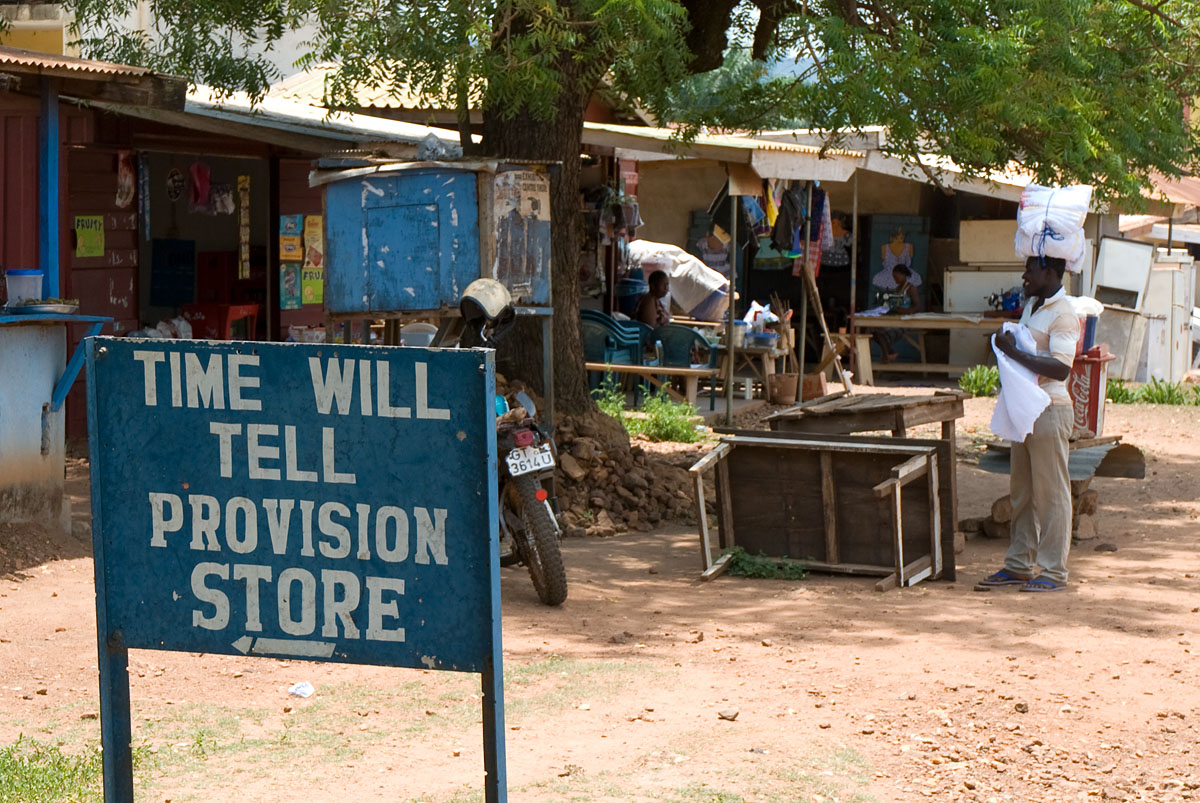
Before we arrived in the country, our guidebooks informed us that Ghana is “15% Muslim, 70% Christian and 100% obsessed with spiritual worship”. Truly, evidence of this devotion can be found everywhere, not least in the comically pious names given to every shop, restaurant, and ramshackle booth in every town we have visited thus far.
The sentiments expressed range from the hopeful (Nothing But Prayer Electricals and General Goods) to the bold (Anointed Internet Café) to the downright threatening (Yours Is Coming Fashion Home), but the theme is consistent. Here is a small sampling of what we’ve found:
Messiah Barber’s Salon
Anointing Hair Craft
The Prophet Store
Peaceful Ark Enterprises
Count Your Blessings Enterprises
Time Will Tell Provision Store
‘God’ the Provider’s Shop
Jesus Fill My Cup Salon
Say Amen Communication and Business Centre
God’s Grace Fashion Home and Provision Store
God’s Time is the Best Fashion Home
Beautiful Zion Multi-Purpose Business Centre
You Can’t Touch By The Blood of Jesus Mama Rose Fast Food
And my personal favourite:
People Don’t Know But Who Will Tell Them Oh Father Forgive Them Meat Shop


The sentiments expressed range from the hopeful (Nothing But Prayer Electricals and General Goods) to the bold (Anointed Internet Café) to the downright threatening (Yours Is Coming Fashion Home), but the theme is consistent. Here is a small sampling of what we’ve found:
Messiah Barber’s Salon
Anointing Hair Craft
The Prophet Store
Peaceful Ark Enterprises
Count Your Blessings Enterprises
Time Will Tell Provision Store
‘God’ the Provider’s Shop
Jesus Fill My Cup Salon
Say Amen Communication and Business Centre
God’s Grace Fashion Home and Provision Store
God’s Time is the Best Fashion Home
Beautiful Zion Multi-Purpose Business Centre
You Can’t Touch By The Blood of Jesus Mama Rose Fast Food
And my personal favourite:
People Don’t Know But Who Will Tell Them Oh Father Forgive Them Meat Shop



Saturday, April 11, 2009
Giving Back
As we round the corner of our last week – our last weekend and, by the time this is posted, the end of our volunteering time – it seems appropriate to put into words some thoughtful reflection on what exactly this experience has meant to us.
Certainly, as the blog can attest, it has been an experience full of both joys and frustrations. We feel sure that this record, unfortunately, has probably been more faithful to the latter than the former. And while it’s difficult to say exactly what we will make of this whole thing a year from now, perhaps while braving the last of winter and (if we could even imagine such a thing) feeling a touch of cold, we can say now that our time here has been positive, exciting, and entirely the adventure we sought.
About Paul’s work, at EDYM and beyond, we can’t say enough good things. He has impressed us with his hopefulness, energy, and tenacity. We hope that our time in Have has leant a small measure of sustainability to the project and extended the promise of realizing Paul’s dreams for the program. Although we think that our small contribution has been worthwhile, we feel more than ever that true and lasting change for this or any community will come from the passion and commitment of people like Paul.
It would be a lie and entirely disingenuous to say that everyone we met was lovely. Certainly at times we felt like we were fighting a two-man losing battle against ages of misconceptions and prejudices. We met many people who seemed to appreciate why we were here but still more who understandably did not, and in those cases it was sometimes difficult to deal with their expectations. For one thing, we became keenly aware of the resentment we felt towards those who demanded things of us that we would have otherwise freely given.
Perhaps the biggest surprise (though it really should have been no surprise at all) was finding out that our time volunteering in Have was considered to be the beginning of a relationship with the organization and the community, not an end unto itself. As such, we sometimes found it difficult to feel as though we’ve given something substantial, knowing that the community still wants more.
Still, if we look for a little perspective, the unique and wonderful experiences of the last two and a half months are hard to ignore. We wanted to stay in a place long enough to feel as though we knew, if only in a small way, what it was like to live there. While Have and EDYM could not be described as a ‘home away from home’ for us, the challenges, familiarity, and finally the comfort that we eventually felt was well worth the gamble.
Certainly, as the blog can attest, it has been an experience full of both joys and frustrations. We feel sure that this record, unfortunately, has probably been more faithful to the latter than the former. And while it’s difficult to say exactly what we will make of this whole thing a year from now, perhaps while braving the last of winter and (if we could even imagine such a thing) feeling a touch of cold, we can say now that our time here has been positive, exciting, and entirely the adventure we sought.
About Paul’s work, at EDYM and beyond, we can’t say enough good things. He has impressed us with his hopefulness, energy, and tenacity. We hope that our time in Have has leant a small measure of sustainability to the project and extended the promise of realizing Paul’s dreams for the program. Although we think that our small contribution has been worthwhile, we feel more than ever that true and lasting change for this or any community will come from the passion and commitment of people like Paul.
It would be a lie and entirely disingenuous to say that everyone we met was lovely. Certainly at times we felt like we were fighting a two-man losing battle against ages of misconceptions and prejudices. We met many people who seemed to appreciate why we were here but still more who understandably did not, and in those cases it was sometimes difficult to deal with their expectations. For one thing, we became keenly aware of the resentment we felt towards those who demanded things of us that we would have otherwise freely given.
Perhaps the biggest surprise (though it really should have been no surprise at all) was finding out that our time volunteering in Have was considered to be the beginning of a relationship with the organization and the community, not an end unto itself. As such, we sometimes found it difficult to feel as though we’ve given something substantial, knowing that the community still wants more.
Still, if we look for a little perspective, the unique and wonderful experiences of the last two and a half months are hard to ignore. We wanted to stay in a place long enough to feel as though we knew, if only in a small way, what it was like to live there. While Have and EDYM could not be described as a ‘home away from home’ for us, the challenges, familiarity, and finally the comfort that we eventually felt was well worth the gamble.
Thursday, April 2, 2009
Seven, Eight, Nine
To say that I have mixed feelings about our looming departure might be a bit of an understatement. As it stands a little over a week away, my current mood, as it has been over the last week, is one of decided conflict. When the heat is in the forties and I’m fighting desperate boredom at the farm, I’m ready as ever to leave. When Sam and I are planning our adventures to come or rehashing some ridiculous daydream of food, I’m just aching for us to be on our own, masters of our own destiny once more. But when I’m sitting at the library getting the regular visits from various friends that I’ve made, I feel exceedingly misguided and guilty in my eagerness to depart. Yesterday I felt that I could not have been more miserable yet today, as the tro-tro driver and mate waved to Sam as he saw me off to the library, I felt sad to think that in a short time we should just disappear to all these people who’ve become used to our presence here, and whose company we have enjoyed in our escapades around town. I even felt sad that I should not know exactly how to say goodbye to the nice lady who lets me use her toilet on the days I spend at the library, not to mention the other people with whom I’ve had more than perfunctory conversations. It would be fair to say that overall, I think, I am tired, and my nerves and emotions are raw.
In my better moods, I am trying ever so hard to be present in those moments of clarity when I’m really enjoying myself and completely aware of what a rare experience we’re having. One of those such moments came a few Fridays ago when Paul took me on a trip to a fishing village on the lakeside North of the farm, off the main road near Vakpo. In this village fishing is considered a very important and profitable business; so important that the village children are often found labouring in the boats rather than going to school. Because parents must pay to enroll their children in public schools (uniforms and transportation are the principle expenses) and because the young ones are considered more adept at diving and untangling the snagged nets, a lack of education is a serious threat to the futures of the children and the village.
However, near this village there lives a woman, whom Paul has made an acquaintance, who has taken it upon herself to open a private school for these children. Out of her pocket she has arranged a shuttle to and from the lakeside, about 2 kms away, and donated fabric for school uniforms. Teachers have volunteered and this woman feeds the crowd of 50-80 students one square meal every day, free of charge. The school buildings, if they could be called that, are rickety and impermanent at best, and Paul hopes to apply for funding to build more substantial structures which would protect the children from the elements, and provide a proper venue for their studies. My job on that Friday was to photograph the school and the nearby village in the hopes that these documents might strengthen the appeal. The whole experience was a real thrill and I reveled in my feelings of usefulness as well as the selfish excitement of having snagged such a juicy assignment. Speeding back to the farm on the back of Paul’s bike I knew that I was having a really, really good time.
As we entered our eighth week Paul had a few more surprises for us to break the weekly routine and we found ourselves away from the farm on various other outings. Saturday the 21st of March we went to the town of Ve-Deme, on the road to Hohoe, for a ceremony in honour of the local government representative who had recently been appointed Regional Minister by the new president. The order of the day was welcoming local dignitaries, honouring the Regional Minister with the conferring of bracelets by the local “Queens”, and drumming and dancing, as well as speeches. The next Monday Paul organized for two affable older farmers to take us on an admittedly not-so-leisurely hike (at times reminiscent of the sweaty tramp up Afadjato) up the mountains next to Have, in order to see and photograph some of the farmfields which perch on these slopes.
Otherwise our routine has been fairly set. I go to the library, where I work away under the relief of the fan and wait for about two o’clock in the afternoon when the children start to arrive. Sam works at the farm, hoeing this field or that Mango grove, watering the plants and seedlings, burning brush and always dripping with sweat. We struggle through our meals which are always disappointing, though we reflect that they are not so bad as they once were since we have forgotten what it was like to enjoy food. We brave the heat, which though it has been actually worse some days (we have measured up to 45 degrees) is on the whole much better, especially at night now that a rainshower is an almost daily guarantee. Showers (of the washing variety) come and go as well, but not for long spells. Guests drop in at the farm, and we are generally commended for our attempts at Ewe. By the time we leave Sam will have bested me in number of pages read, but I will surely take the competition of Gin Rummy.
We think of home and family and friends often. Though our fleeting and infrequent internet visits don’t allow for much correspondence from our end, we revel in each note which we read and then save, to re-read and read aloud once we’ve returned from town. For those who might be worried about our capacity to suffer this strange and hot climate, rest assured that we have mapped and memorized the location of the best burger joint in Accra and plan to spend my birthday and a few days thereafter in the blissfully named “Coconut Grove Beach Resort” on the sandy shores of the Gulf of Guinea, West of the picturesque and historic seaside town of Elmina.
Subscribe to:
Posts (Atom)